
ASTM B88 Copper Pipe Comparison: Type K vs. Type L vs. Type M
Under ASTM B88, nominal 3/4 in. potable copper tube shares an identical 0.875 in. Outside Diameter across all grades, allowing shared solder and ProPress fittings, while wall thickness steps down from Type K green ink (0.065 in., 0.745 in. ID) to Type L blue ink (0.045 in., 0.785 in. ID) and Type M red ink (0.032 in., 0.811 in. ID), dictating underground burial approval and pitting resistance.
- Option A
- Type L (Blue — Interior Standard)
- Option B
- Type K (Green) & Type M (Red)
- Decision Criteria
- 6 Audited Metrics
- Governing Basis
- ASTM B88 & IPC/UPC
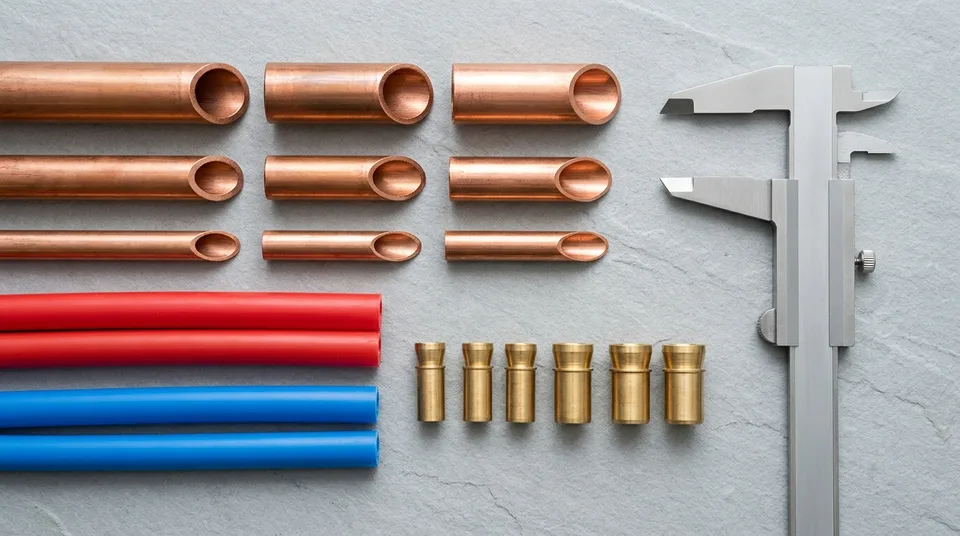
Wall thickness & hydraulic ID: on 3/4 in. nominal tube (0.875 in. OD), Type K's 0.065 in. wall yields a 0.745 in. ID (0.436 sq in. bore), Type L's 0.045 in. wall yields 0.785 in. ID (0.484 sq in.), and Type M's 0.032 in. wall yields 0.811 in. ID (0.517 sq in.).
Corrosion margin: Type K carries 103% thicker copper walls than Type M at 3/4 in. size, making Type K mandatory for direct burial under IPC/UPC and preferred where low-pH (<6.5) water causes cuprosolvency pitting.
How Do Type L (Blue — Interior Standard) and Type K (Green) & Type M (Red) Compare Metric by Metric?
This normalized comparison evaluates 6 primary technical criteria grounded in ASTM B88 & IPC/UPC, highlighting efficiency, code compliance, and retrofit constraints.
| Parameter | Type L (Blue — Interior Standard) | Type K (Green) & Type M (Red) | Engineering Takeaway |
|---|---|---|---|
| Color Ink Stamp | Blue ink | Type K: Green | Type M: Red | Stamped along tube length |
| 1/2 in. Wall / ID (0.625 OD) | 0.040 in. wall / 0.545 in. ID | K: 0.049 / 0.527 | M: 0.028 / 0.569 | All fit identical 1/2 in. sweat/ProPress fittings |
| 3/4 in. Wall / ID (0.875 OD) | 0.045 in. wall / 0.785 in. ID | K: 0.065 / 0.745 | M: 0.032 / 0.811 | OD constant at 0.875 in. |
| 1 in. Wall / ID (1.125 OD) | 0.050 in. wall / 1.025 in. ID | K: 0.065 / 0.995 | M: 0.035 / 1.055 | Main supply trunk sizing |
| Underground Burial Code | Permitted in select jurisdictions | Type K required; Type M prohibited | Verify local soil corrosivity & sleeve rules |
| Aggressive Low-pH Water | Standard interior water supply | K longest corrosion life; M thins fastest | Check pH < 6.5 / blue-green stains |
When Do Code and Field Conditions Favor Each Option?
Match your home's existing utility connections, ambient room air, tap water hardness, and local code cycle against the field selection criteria below before ordering equipment.
Choose Type L (Blue — Interior Standard) When:
- Above-ground residential and commercial potable repipes
- Balanced durability vs. material expense under IPC/UPC
Choose Type K (Green) & Type M (Red) When:
- Type K: underground water service mains & slab penetrations
- Type M: hydronic heating loops & budget above-ground repairs where local code permits
What Are the Limitations of Type L (Blue — Interior Standard) vs. Type K (Green) & Type M (Red)?
Neither Type L (Blue — Interior Standard) nor Type K (Green) & Type M (Red) fits all existing mechanical spaces, gas lines, or municipal code zones.
Key Limitations & Exclusions
- Wall thickness & hydraulic ID: on 3/4 in. nominal tube (0.875 in. OD), Type K's 0.065 in. wall yields a 0.745 in. ID (0.436 sq in. bore), Type L's 0.045 in. wall yields 0.785 in. ID (0.484 sq in.), and Type M's 0.032 in. wall yields 0.811 in. ID (0.517 sq in.).
- Corrosion margin: Type K carries 103% thicker copper walls than Type M at 3/4 in. size, making Type K mandatory for direct burial under IPC/UPC and preferred where low-pH (<6.5) water causes cuprosolvency pitting.
- Verify local municipal amendments and physical rough-in clearances before purchasing.
Which Option Fits Your Situation?
What Are the Key Questions and Answers?
Direct answers to common technical, regulatory, and sizing questions sourced from primary U.S. government and OEM documentation.
Where do the engineering metrics for ASTM B88 Copper Pipe Comparison: Type K vs. Type L vs. Type M originate?
Data provenance for ASTM B88 Copper Pipe Comparison: Type K vs. Type L vs. Type M links straight to verified agency releases and OEM installation bulletins. Evaluates Type L (Blue — Interior Standard) against Type K (Green) & Type M (Red) using ASTM B88 & IPC/UPC.
When should homeowners stop and call 911 or a pro on ASTM B88 Copper Pipe Comparison: Type K vs. Type L vs. Type M?
Online tables clarify baseline engineering limits, not site-specific hazards like live gas odors or corroded service mains. Confirm physical dimensions, fuel lines, and local AHJ permit requirements prior to installation.
Which federal regulatory baselines intersect with ASTM B88 Copper Pipe Comparison: Type K vs. Type L vs. Type M?
Check local Authority Having Jurisdiction amendments to IPC/UPC codes alongside federal EPA drinking water and 10 CFR 430 efficiency mandates.
Which incentives remain open in 2026 for plumbing equipment?
Verify active state DOE HEAR allocations (up to $1,750 for heat pump water heaters) and local utility rebates following the Dec 31, 2025 25C expiration.
When should a homeowner escalate ASTM B88 Copper Pipe Comparison: Type K vs. Type L vs. Type M to a state-licensed plumber?
Escalate whenever tasks involve fuel-gas piping, Category IV exhaust venting, 240V electrical circuits, main shutoff valves, or permitted sewer excavations.
Does TapAndPipe accept paid placements inside ASTM B88 Copper Pipe Comparison: Type K vs. Type L vs. Type M?
No. All specifications, state benchmarks, and contractor lists derive strictly from official public records and OEM manuals with zero paid ranking boosts.
Sources
- ASTM B88 Copper Water Tube & ASME B1.20.1 Pipe Threads — ASTM International & ASME, ASTM B88 / F876 / ASME B1.20.1 (retrieved 2026-11-23)
- International Plumbing Code (IPC) & International Fuel Gas Code (IFGC Table 402.4) — International Code Council (ICC), 2021 / 2024 IPC & IFGC (retrieved 2026-11-23)
- Uniform Plumbing Code (UPC) & State Code Adoptions — International Association of Plumbing and Mechanical Officials (IAPMO), 2021 / 2024 UPC (retrieved 2026-11-23)