
Electric Tankless & Instant Water Heaters: kW, Amps & 2026 Guide
Instant electric tankless water heaters heat water directly across high-wattage resistance elements without storage tanks or gas combustion flues, using the thermodynamic equation GPM = (kW x 3,412 BTU/h) / (500 x Temperature Rise °F). While 0 electric tankless models currently hold EPA ENERGY STAR certification (compared with 706 hybrid heat pump models), whole-house 18–36 kW units require 75 to 150 amps across dual or triple 240V breakers—making electrical panel verification essential in 2026.
- Thermal Conversion
- 1 kW = 3,412 BTU/h
- Whole-House 240V Load
- 18–36 kW (75–150 A)
- Point-of-Use (<=2 gal)
- 3.5–9 kW (120V/240V)
- ENERGY STAR Count
- 0 Electric Tankless
- DOE 2029 Storage Alt.
- HPWH >=2.30 UEF
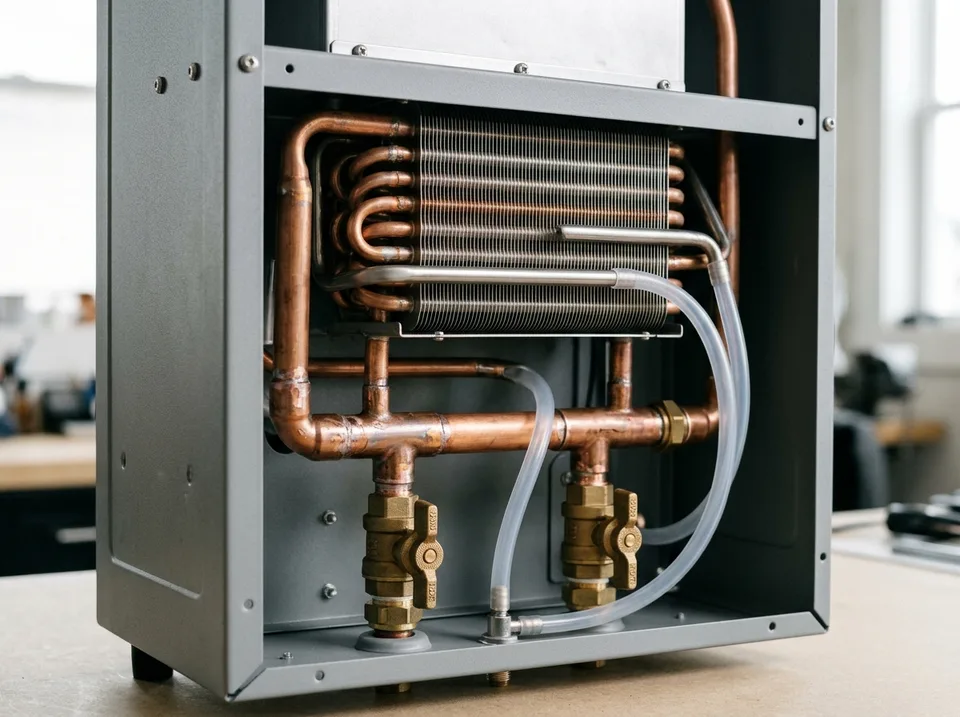
How Many kW and Amps Does an Electric Tankless Water Heater Need?
Calculate required kW output and 240V breaker amperage from target GPM flow and incoming winter groundwater temperature using the thermodynamic formula GPM = BTU/h / (500 × ΔT).
Why electric panel sizing matters: heating 4.0 GPM from 50 °F winter groundwater to 120 °F requires 140,000 BTU/h, or ~41 kW (~171 A at 240V)—exceeding an entire 100A main service panel.
Point-of-use sweet spot: compact 120V/240V instant heaters under 2 gal excel under remote guest sinks (0.5–1.5 GPM) to eliminate long pipe wait times without repiping gas.
Why Does Cold Groundwater Limit Electric Tankless Flow Rates?
Every degree of winter temperature rise slashes instantaneous GPM capacity because residential 240V wiring tops out around 150 amps (36 kW). At 70 °F southern groundwater (50 °F rise to 120 °F), a 27 kW unit delivers ~3.7 GPM, whereas at 40 °F northern winter groundwater (80 °F rise), output drops to 2.3 GPM—barely serving one showerhead.
How Do Electric Tankless Units Compare to Heat Pump Tanks and Gas Tankless?
EPA ENERGY STAR certifies 706 hybrid heat pump tanks (3.30–4.05 UEF) and condensing gas tankless units (0.91–0.96 UEF) rather than electric resistance instantaneous heaters. A 3.75 UEF HPWH uses roughly 900 kWh/yr (~$163/yr at 18.16 cents/kWh) on a single 30A 240V circuit versus ~3,400–4,200 kWh/yr on resistance heating.
What Breaker Amperage and GPM Output Apply by Electric Tankless Size?
Every threshold below is sourced from U.S. government datasets, published model code section citations, or OEM service documentation.
| Unit Output | BTU/h Equiv. | 240V Current | Suggested Breakers | GPM @ 50°F Rise (70°F In) | GPM @ 70°F Rise (50°F In) | Typical Use |
|---|---|---|---|---|---|---|
| 6.5 kW | 22,178 BTU/h | 27.1 A | 1x 30A 240V | 0.9 GPM | 0.6 GPM | Single lavatory sink (POU) |
| 11 kW | 37,532 BTU/h | 45.8 A | 1x 60A 240V | 1.5 GPM | 1.1 GPM | Single low-flow shower (warm south) |
| 18 kW | 61,416 BTU/h | 75.0 A | 2x 40A 240V | 2.5 GPM | 1.8 GPM | 1 bath + 1 sink (southern US) |
| 24 kW | 81,888 BTU/h | 100.0 A | 2x 60A or 3x 40A | 3.3 GPM | 2.3 GPM | 1–2 baths (moderate climate) |
| 27 kW | 92,124 BTU/h | 112.5 A | 3x 40A 240V | 3.7 GPM | 2.6 GPM | 2 simultaneous low-flow showers (south) |
| 36 kW | 122,832 BTU/h | 150.0 A | 3x 60A or 4x 40A | 4.9 GPM | 3.5 GPM | Whole-house max (needs 200A+ panel) |
Who Should NOT Install a Whole-House Electric Tankless Water Heater?
Zero combustion flues make electric tankless units attractive on paper, yet electrical panel capacity and cold northern groundwater create hard physics boundaries.
Key Limitations & Exclusions
- Homes with 100A or 150A electrical main panels cannot support 27–36 kW (112–150A) loads alongside HVAC, range, and EV chargers without a $2,500+ service upgrade.
- Northern states with 40–45 °F winter water temperatures suffer sharp GPM throttling during simultaneous showers.
- EPA ENERGY STAR and DOE HEAR rebates ($1,750 max) target hybrid heat pump storage tanks rather than electric resistance instantaneous units.
Which Option Fits Your Situation?
What Do Homeowners Ask Most About This Topic?
Direct answers to common technical, regulatory, and sizing questions sourced from primary U.S. government and OEM documentation.
Can I use 30% vinegar to flush my tankless water heater?
Standard OEM descaling manuals from Rinnai and Navien specify circulating 4 gallons of household 5% food-grade white vinegar or an NSF-approved descaling solution for 30 to 45 minutes. Undiluted 30% concentrated acetic acid can swell elastomeric O-rings and etch brass isolation valve components unless specifically diluted first.
How often should a tankless water heater be cleaned?
OEM manufacturers recommend flushing condensing and non-condensing tankless heat exchangers every 12 months when tap water reaches or exceeds 7.0 GPG USGS Hard classification, and every 6 months in Very Hard water above 10.5 GPG, alongside cleaning the cold-water inlet filter mesh screen.
Should you flush a 10 year old water heater?
Exercise caution before aggressively flushing an unmaintained 10-year-old storage tank water heater, because calcified sediment may already be sealing hairline corrosion pinholes along the bottom seam. Decode your serial number age first; storage tanks average 8–12 years, whereas a 10-year-old tankless exchanger with clean brass valves still benefits from annual descaling.
Why are plumbers against tankless water heaters?
Field plumbers flag tank-to-tankless retrofits mainly when homeowners expect a drop-in swap. A 199,000 BTU/h gas tankless unit often exceeds existing 1/2 in. Sch 40 gas capacity beyond 10 ft under IFGC Table 402.4, requires Category IV PVC venting, and needs annual descaling in hard water above 7.0 GPG.
How big of a tankless water heater do I need to replace a 40 gallon water heater?
Size replacement tankless units by peak simultaneous GPM flow and incoming winter groundwater temperature rise rather than gallon count. Two concurrent 2.0 GPM showers plus a kitchen tap demand 5.0–6.0 GPM; at 50 °F incoming water heated to 120 °F, that requires 175,000–199,000 BTU/h gas or 27–36 kW electric.
What size tankless water heater for 3 bedroom 2 bath house?
A 3-bedroom, 2-bath residence running two simultaneous 2.0 GPM showers and a dishwasher typically requires 5.5–7.5 GPM output at a 60–70 °F temperature rise. That matches a 180,000–199,000 BTU/h condensing gas unit (0.91–0.96 UEF) or a 27–36 kW 240V electric model requiring 112–150 amps.
What is the most common problem with tankless water heaters?
Ignition lockouts such as Rinnai 11 and Navien E003 during peak demand are the leading installation fault, commonly caused by undersized 1/2 in. gas piping unable to carry 199 CFH under IFGC Table 402.4. In service, mineral scale buildup above 7.0 GPG hardness and dirty flame sensors rank next.
What's the average lifespan of a water heater?
Standard atmospheric gas and electric resistance storage tanks average 8 to 12 years, depending on tap water hardness and 4-to-6-year sacrificial anode rod replacement. Condensing gas tankless heat exchangers average 15 to 20 years when flushed annually and kept free of calcium scale.
Sources
- 10 CFR 430.32 — Energy and Water Conservation Standards (Water Heaters & Plumbing Fixtures) — U.S. Department of Energy / eCFR, 2026 eCFR (incl. May 6, 2029 Rule) (retrieved 2026-11-23)
- ENERGY STAR Certified Water Heaters Dataset (Socrata pbpq-swnu) — U.S. EPA & DOE ENERGY STAR, 2026 Live Certified Registry (retrieved 2026-11-23)
- EIA Electric Power Monthly Table 5.6.A — Average Residential Electricity Price by State — U.S. Energy Information Administration (EIA), August 2026 Monthly Release (retrieved 2026-11-23)