
24-Hour Emergency Plumber Triage, Shutoff Rules & 2026 Rates
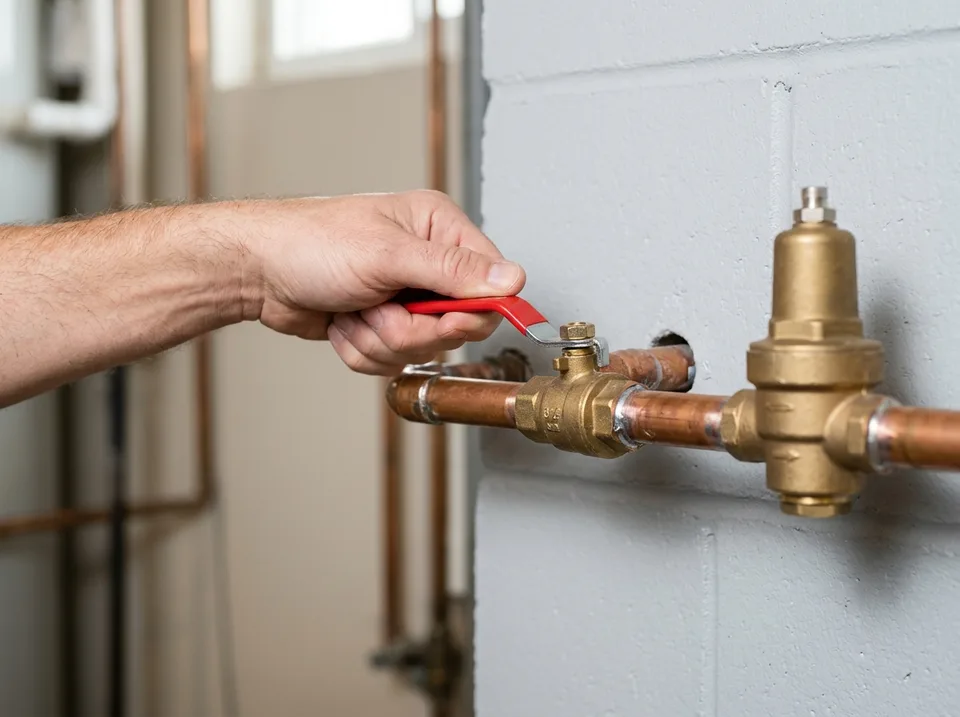
Before dispatching a 24-hour emergency plumber, homeowners can halt structural water damage within 0–15 minutes by turning the main house ball valve perpendicular to the pipe, cutting affected electrical breakers safely, and evacuating immediately to call 911 if mercaptan gas odors are detected. May 2024 U.S. Bureau of Labor Statistics data puts US state-median employee plumber pay at $30.80/hr ($20.00–$49.00+/hr across 51 jurisdictions), while emergency night/weekend dispatches add contractor truck overhead and after-hours multipliers.
- Gas Odor Gate
- Evacuate & Call 911
- Shutoff Window
- 0–15 Minutes
- BLS Median Straight Pay
- $29.98/hr
- Freeze Burst Risk
- <= 20 °F Sustained
- Static Supply Ceiling
- 80 psi (IPC §604.8)
911 gas rule comes first: natural gas rises toward ceiling joists while heavier-than-air propane (1.50 SG) pools along basement floors. Never flip light switches or unplug cords inside a structure smelling of gas.
Daytime vs. 24-hour emergency billing: isolating the main valve and waiting for regular daytime scheduling avoids emergency after-hours overtime dispatch premiums when flooding is fully stopped.
What Immediate Steps Stop Flooding Before an Emergency Plumber Arrives?
Turning a quarter-turn main ball valve 90 degrees perpendicular to the supply pipe halts incoming 50–80 psi water flow immediately. Once water flow stops and breakers near damp ceilings are switched off safely from a dry floor, most homeowners can wait for daytime licensed scheduling rather than paying emergency night surcharges.
If you smell rotten eggs, leave immediately without flipping switches and call 911 outdoors.
Turn quarter-turn ball valve perpendicular to pipe (or gate valve clockwise); open lowest cold tap.
Confirm active state board license ID and upfront night/weekend dispatch fee before dispatch.
How Much Do Emergency Plumbers Cost Compared With Daytime BLS Rates?
May 2024 U.S. Bureau of Labor Statistics employee median straight-time wages average $29.98/hr nationally, scaling near $55.00/hr under a typical 1.85x daytime contractor overhead factor. Night, weekend, and holiday emergency dispatches commonly add overtime labor multipliers and diagnostic truck-roll dispatch fees; verify exact pricing before authorizing repairs.
Which Emergency Scenarios Require 911 Dispatch vs. Water Shutoff?
Every threshold below is sourced from U.S. government datasets, published model code section citations, or OEM service documentation.
| Emergency Event | Urgency & First Step | Wait for Daytime? | TapAndPipe Playbook |
|---|---|---|---|
| Natural Gas / Propane Odor | Evacuate & Call 911 (Do not touch switches) | No — 911 & gas utility immediately | Gas Odor Protocol |
| Frozen / Burst Supply Pipe | Shut main ball valve perpendicular + drain tap | Yes once isolated & dry | Burst Pipe Shutoff |
| Leaking Water Heater Tank | Close cold tank inlet + cut breaker/gas | Yes once cold supply stops | Tank Leak Isolation |
| T&P Valve Steam / Boiling Vent | Cut power/gas; never cap T&P pipe | Urgent same-day licensed service | T&P Relief Triage |
| Main Sewer Line Backup | Halt toilets/washers; check exterior cleanout | Depends on active sewage level | Sewer Backup Protocol |
When Should You Call 911 Instead of an Emergency Plumber Directory?
Emergency plumbing directories help locate state-licensed contractors for pipes and tanks, never active utility gas leaks or submerged electrical panels.
Key Limitations & Exclusions
- Active mercaptan gas odors or carbon monoxide alarms require outdoor evacuation and 911 dispatch before calling any plumbing contractor.
- Do not step into standing basement water to reach breaker boxes or plugged sump pumps.
- Always confirm after-hours emergency dispatch fees and active state license numbers on the phone before authorizing truck dispatch.
Which Option Fits Your Situation?
What Do Homeowners Ask Most About This Topic?
Direct answers to common technical, regulatory, and sizing questions sourced from primary U.S. government and OEM documentation.
How much for a plumber for 3 hours?
Using May 2024 U.S. Bureau of Labor Statistics employee wage data ($29.98/hr national state median pay), 3 hours of employee base pay equal $90. Applying a typical 1.85x licensed contractor truck, insurance, and overhead multiplier puts estimated 3-hour billed labor near $166 before parts or permits.
How much does a plumber charge for 4 hours of work?
At the May 2024 U.S. Bureau of Labor Statistics national state median employee wage of $29.98/hr, 4 hours of base pay total $120. Modeling standard 1.85x licensed contractor overhead puts 4 hours of billed residential labor near $222, rising in high-wage states like Illinois, Massachusetts, California, and Washington.
Are 24 hour plumbers more expensive?
Yes. May 2024 U.S. Bureau of Labor Statistics wages measure straight-time employee pay rather than contractor dispatch rates; emergency nights, weekends, and holiday calls typically add after-hours dispatch fees and overtime labor multipliers on top of daytime service rates to cover on-call truck readiness.
What questions should I ask a plumber?
Confirm their active state plumbing license number (such as Texas TSBPE RMP or state board ID), verify general liability and workers' compensation certificates, ask whether municipal permits and inspection fees are itemized in writing, and confirm flat-rate versus hourly overtime billing before work starts.
How do I find a good plumber?
Verify active state licensing standing directly on your state plumbing board portal rather than relying solely on star-rating ads. Request 2 to 3 written itemized scopes specifying permit numbers, ASME/IPC material grades (such as Type L copper vs. F1960 PEX-A), and disposal of old equipment.
What is a temporary fix for a hole in a pipe?
First close the main quarter-turn shutoff valve perpendicular to the pipe and open the lowest cold tap to bleed 50–80 psi line pressure. For minor pinhole weeping until a licensed plumber replaces the damaged section, clamp an EPDM rubber sleeve with stainless steel hose clamps or install an ASME-rated push-fit coupling.
What are the two types of plumbing?
Residential plumbing splits into two distinct pressurized and gravity networks: potable water supply and distribution piping (operating under 40–80 psi pressure under IPC Chapter 6) and Drain-Waste-Vent (DWV) sanitary gravity piping sloped at 1/8 to 1/4 in. per foot under IPC Chapter 7.
Can a plumber make $100,000 a year?
Yes. While May 2024 U.S. Bureau of Labor Statistics figures place the national state median employee plumber wage at $29.98/hr ($62,358/yr full-time), 90th-percentile experienced plumbers in unionized and coastal states (MA, IL, CA, WA, NY, NJ) earn $49 to $65+ per hour, exceeding $100,000 annually before overtime.
Sources
- OEWS State Employment & Wage Estimates — SOC 47-2152 Plumbers, Pipefitters, and Steamfitters — U.S. Bureau of Labor Statistics, May 2024 OEWS (retrieved 2026-11-23)
- NFPA 54 / ANSI Z223.1 National Fuel Gas Code (Gas Pipe Sizing Ch. 6) — National Fire Protection Association, 2024 Edition (retrieved 2026-11-23)
- International Plumbing Code (IPC) & International Fuel Gas Code (IFGC Table 402.4) — International Code Council (ICC), 2021 / 2024 IPC & IFGC (retrieved 2026-11-23)
- USDA Plant Hardiness Zone Map ZIP Code Extreme Minimum Temperatures — USDA ARS & Oregon State PRISM Climate Group, 2023 PHZM ZIP Table (retrieved 2026-11-23)