
Salt-Based Water Softener vs. Salt-Free Scale Conditioner
Salt-based ion-exchange water softeners physically remove calcium and magnesium hardness ions down to near 0 GPG using sodium chloride regeneration, whereas salt-free template-assisted crystallization (TAC) conditioners leave hardness minerals dissolved in tap water while reducing pipe scale crystal adhesion. Across 16 USGS Water Quality Portal state datasets exceeding 7.0 GPG Hard tiers (up to 36.1 GPG in California and 15.6 GPG in Ohio), salt-based systems perform best for water heaters unless local municipal brine discharge bans apply.
- Option A
- Salt-Based Ion Exchange
- Option B
- Salt-Free TAC Conditioner
- Decision Criteria
- 5 Audited Metrics
- Governing Basis
- USGS WQP Hardness & Municipal Brine Rules
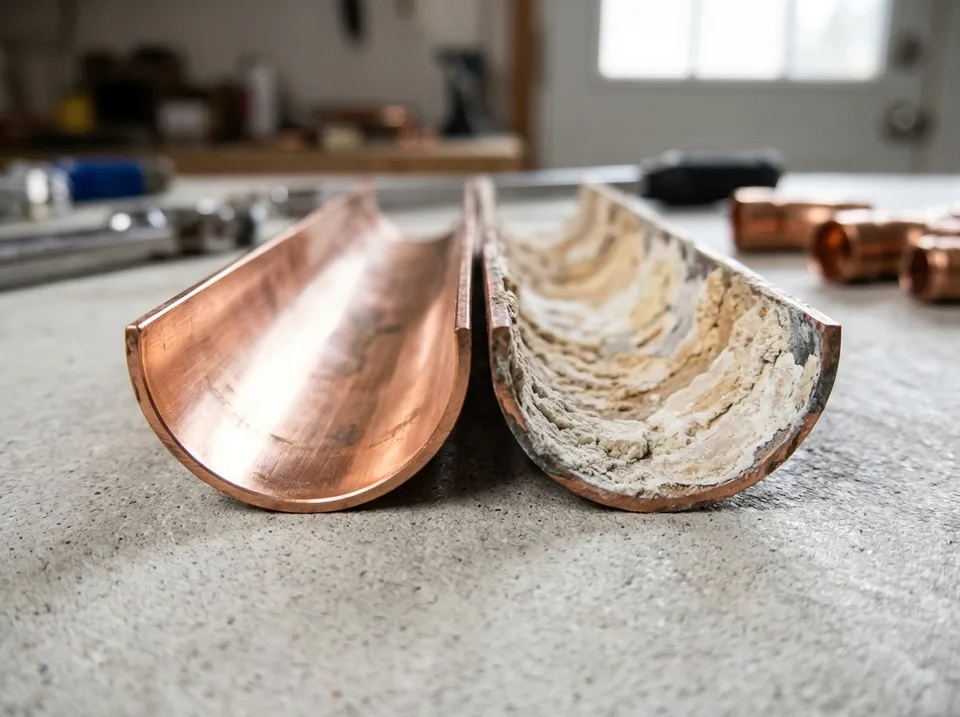
Chemical distinction: ion-exchange resin swaps Ca2+ and Mg2+ ions for sodium ions, regenerating roughly every 7 days using ~8–10 lb salt per 32,000-grain cycle (~4–5 weeks per 40 lb bag at 10 GPG).
Regulatory boundary: wastewater authorities in Santa Clarita Valley (CA), chloride-impaired Minnesota watersheds, and select Southwest basins restrict chloride brine discharge—making salt-free TAC or cartridge-exchange service mandatory there.
How Do Salt-Based Ion Exchange and Salt-Free TAC Conditioner Compare Metric by Metric?
This normalized comparison evaluates 5 primary technical criteria grounded in USGS WQP Hardness & Municipal Brine Rules, highlighting efficiency, code compliance, and retrofit constraints.
| Parameter | Salt-Based Ion Exchange | Salt-Free TAC Conditioner | Engineering Takeaway |
|---|---|---|---|
| Hardness Mineral Removal | Removes Ca2+ & Mg2+ (<1 GPG output) | Does not remove hardness minerals | Soap lathering improves only with ion exchange |
| Tankless Scale Protection | Strong protection >=7.0–30+ GPG | Effective primarily <=15–20 GPG low-iron water | Test clear-water iron (+4x Fe GPG penalty) |
| Annual Consumable Maintenance | 40 lb salt bags (~4–5 wks @ 10 GPG) | Media replacement every 3–5 yrs; no salt | No electricity or drain line needed for TAC |
| Brine Discharge Restrictions | Restricted in SCV CA & MN chloride zones | 100% exempt from brine bans | Zero chloride wastewater discharge |
| Low-Sodium / Well Iron Fit | Adds ~20–30 mg Na per 8 oz @ 10 GPG | Zero added sodium; fails if Fe >0.3 ppm | Install pre-filter or RO tap if needed |
When Do Code and Field Conditions Favor Each Option?
Match your home's existing utility connections, ambient room air, tap water hardness, and local code cycle against the field selection criteria below before ordering equipment.
Choose Salt-Based Ion Exchange When:
- Tap water >=7.0 GPG Hard or Very Hard (>10.5 GPG) with gas tankless heaters
- Soap spotting, glass etching, and appliance scale reduction priority
- Municipal sewer permits standard brine regeneration
Choose Salt-Free TAC Conditioner When:
- Local ordinance bans residential salt-regenerating brine discharge
- Tight utility room lacking floor drain or 120V outlet
- Low-sodium drinking target without reverse osmosis bypass
What Are the Limitations of Salt-Based Ion Exchange vs. Salt-Free TAC Conditioner?
Neither Salt-Based Ion Exchange nor Salt-Free TAC Conditioner fits all residential floor plans, municipal ordinances, or utility connections without field verification.
Key Limitations & Exclusions
- Chemical distinction: ion-exchange resin swaps Ca2+ and Mg2+ ions for sodium ions, regenerating roughly every 7 days using ~8–10 lb salt per 32,000-grain cycle (~4–5 weeks per 40 lb bag at 10 GPG).
- Regulatory boundary: wastewater authorities in Santa Clarita Valley (CA), chloride-impaired Minnesota watersheds, and select Southwest basins restrict chloride brine discharge—making salt-free TAC or cartridge-exchange service mandatory there.
- Verify local municipal permits and physical installation clearances prior to purchasing equipment.
Which Option Fits Your Situation?
What Are the Key Questions and Answers?
Direct answers to common technical, regulatory, and sizing questions sourced from primary U.S. government and OEM documentation.
How long should 40 pounds of salt last in a water softener?
Under USGS household water usage of 75 gallons per person daily at 10 GPG hardness, a four-person home needs roughly 3,000 grains of daily capacity, or 21,000 grains per week. At typical 8–10 lb salt usage per weekly regeneration, one 40 lb bag lasts about 4 to 5 weeks.
How big of a water softener do I need for a 3 bathroom house?
Size ion-exchange tanks by household occupants and measured USGS tap hardness rather than bathroom count alone. Multiply occupants by 75 gal/day and compensated hardness in GPG plus 4x clear-water iron ppm over a 7-day cycle; 3–4 residents at 10 GPG typically size into a 32,000-to-40,000-grain tank.
Can bacteria grow in a water softener brine tank?
High-salinity sodium chloride brine inhibits most microbial growth, though sediment, iron fouling, or stagnant water above the salt bridge can foster biofilm on tank walls. Cleaning the brine tank annually with mild non-chlorinated detergent or manufacturer-approved resin cleaner keeps the draw assembly sanitary.
Which state has the worst hard water?
Among states sampled in the USGS Water Quality Portal, California recorded 36.1 GPG median hardness across 4 high-mineral sampling sets, Ohio measured 15.6 GPG across 1,500 samples, Arizona measured 13.0 GPG across 173 samples, and Minnesota measured 12.5 GPG across 1,486 samples—all exceeding the 10.5 GPG Very Hard threshold.
Is hard water healthier for you?
Calcium and magnesium hardness ions above 7.0 GPG pose no federal health violation under EPA Safe Drinking Water Act rules, unlike 4.0 ppt PFAS or 10 ppb lead action levels. However, mineral scale coats tankless heat exchangers and tank heating elements, reducing thermal efficiency and shortening equipment service life.
Can I use 30% vinegar to flush my tankless water heater?
Standard OEM descaling manuals from Rinnai and Navien specify circulating 4 gallons of household 5% food-grade white vinegar or an NSF-approved descaling solution for 30 to 45 minutes. Undiluted 30% concentrated acetic acid can swell elastomeric O-rings and etch brass isolation valve components unless specifically diluted first.
How often should a tankless water heater be cleaned?
OEM manufacturers recommend flushing condensing and non-condensing tankless heat exchangers every 12 months when tap water reaches or exceeds 7.0 GPG USGS Hard classification, and every 6 months in Very Hard water above 10.5 GPG, alongside cleaning the cold-water inlet filter mesh screen.
Should you flush a 10 year old water heater?
Exercise caution before aggressively flushing an unmaintained 10-year-old storage tank water heater, because calcified sediment may already be sealing hairline corrosion pinholes along the bottom seam. Decode your serial number age first; storage tanks average 8–12 years, whereas a 10-year-old tankless exchanger with clean brass valves still benefits from annual descaling.
Sources
- National Water Quality Monitoring Council Water Quality Portal (Hardness, Ca, Mg) — USGS & U.S. EPA, WQP Result Service (retrieved 2026-11-23)
- EPA ECHO Safe Drinking Water Act (SDWA) Public Water Systems Download — U.S. Environmental Protection Agency, SDWA System Search Extract (retrieved 2026-11-23)
- U.S. 51-Jurisdiction State Plumbing Licensing Boards & Code Adoption Directory — Official State Contractor & Plumbing Licensing Authorities, 2026 State Board Verification (retrieved 2026-11-23)