
Plumbing Supply Stores & Counter Buying Guide: OEM Specs & Pipe Grades
Knowing exact ASTM pipe standards (Type L vs. Type M copper under ASTM B88), thread tapers (ASME B1.20.1 NPT vs. GHT/compression), and OEM part numbers across 30 valve families lets homeowners buy brass-body cartridges, full-port ball valves, and 3/4 in. IFGC gas components accurately at local wholesale plumbing supply counters. Every benchmark on this page cites primary U.S. government data, IPC/UPC section standards, or official OEM manuals without sponsored rankings.
- OEM Parts Indexed
- 30 Assemblies
- Copper Underground Min
- Type K or L (ASTM B88)
- Gas Supply Pipe
- Sch 40 Black Iron (IFGC)
- Faucet Thread Rule
- NPT Tape vs. GHT Gasket
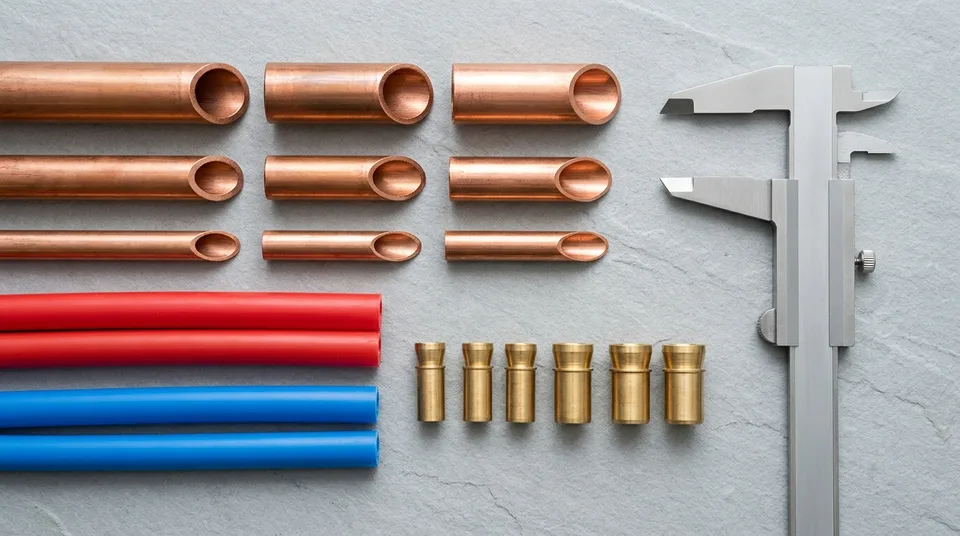
Wholesale vs. retail valve internals: supply houses stock all-brass rough-in bodies (such as Moen 2510/2570 and Delta R10000-UNBX) and genuine OEM cartridges rather than aftermarket thin-plastic clones.
Always bring the old extracted cartridge, model serial tag, and pipe OD/material measurement to the counter before ordering.
What Specs Should You Confirm Before Visiting a Plumbing Supply Counter?
Confirm nominal CTS pipe diameter (1/2 in. = 0.625 in. OD, 3/4 in. = 0.875 in. OD), joining system (F1960 cold-expansion PEX-a vs. F1807 crimp PEX-b vs. sweat copper), and exact OEM part numbers rather than generic faucet brand names.
Which Parts Require Genuine OEM Components Over Generic Aftermarket Kits?
Pressure-balancing shower cartridges (Moen 1222, Delta RP46074, Kohler GP876851), tankless gas valves, and Zurn 975XL RPZ check kits require genuine OEM elastomers and springs to hold anti-scald and backflow compliance.
Who Should Confirm Wholesale Return Policies and Trade Licensing First?
Some wholesale plumbing supply counters restrict gas-manifold controls, refrigerants, or commercial backflow parts to active trade accounts.
Key Limitations & Exclusions
- Call ahead to confirm whether a wholesale branch sells counter parts to walk-in homeowners.
- Gas control valves and tankless burners typically require verified model/serial numbers and licensed installation for warranty.
- Confirm local IPC/UPC code acceptance (e.g., air admittance valves or PVC vs. cast iron DWV) before buying bulk pipe.
Which Option Fits Your Situation?
What Do Homeowners Ask Most About This Topic?
Direct answers to common technical, regulatory, and sizing questions sourced from primary U.S. government and OEM documentation.
How much for a plumber for 3 hours?
Using May 2024 U.S. Bureau of Labor Statistics employee wage data ($29.98/hr national state median pay), 3 hours of employee base pay equal $90. Applying a typical 1.85x licensed contractor truck, insurance, and overhead multiplier puts estimated 3-hour billed labor near $166 before parts or permits.
How much does a plumber charge for 4 hours of work?
At the May 2024 U.S. Bureau of Labor Statistics national state median employee wage of $29.98/hr, 4 hours of base pay total $120. Modeling standard 1.85x licensed contractor overhead puts 4 hours of billed residential labor near $222, rising in high-wage states like Illinois, Massachusetts, California, and Washington.
Are 24 hour plumbers more expensive?
Yes. May 2024 U.S. Bureau of Labor Statistics wages measure straight-time employee pay rather than contractor dispatch rates; emergency nights, weekends, and holiday calls typically add after-hours dispatch fees and overtime labor multipliers on top of daytime service rates to cover on-call truck readiness.
What questions should I ask a plumber?
Confirm their active state plumbing license number (such as Texas TSBPE RMP or state board ID), verify general liability and workers' compensation certificates, ask whether municipal permits and inspection fees are itemized in writing, and confirm flat-rate versus hourly overtime billing before work starts.
How do I find a good plumber?
Verify active state licensing standing directly on your state plumbing board portal rather than relying solely on star-rating ads. Request 2 to 3 written itemized scopes specifying permit numbers, ASME/IPC material grades (such as Type L copper vs. F1960 PEX-A), and disposal of old equipment.
What are the two types of plumbing?
Residential plumbing splits into two distinct pressurized and gravity networks: potable water supply and distribution piping (operating under 40–80 psi pressure under IPC Chapter 6) and Drain-Waste-Vent (DWV) sanitary gravity piping sloped at 1/8 to 1/4 in. per foot under IPC Chapter 7.
Can a plumber make $100,000 a year?
Yes. While May 2024 U.S. Bureau of Labor Statistics figures place the national state median employee plumber wage at $29.98/hr ($62,358/yr full-time), 90th-percentile experienced plumbers in unionized and coastal states (MA, IL, CA, WA, NY, NJ) earn $49 to $65+ per hour, exceeding $100,000 annually before overtime.
How to find a plumber in your area?
Check official state or municipal contractor license lookup portals before booking service, confirm active general liability insurance, and verify whether local IPC or UPC code permits apply for water heater, backflow, or sewer lateral repairs in your city.
Sources
- ASTM B88 Copper Water Tube & ASME B1.20.1 Pipe Threads — ASTM International & ASME, ASTM B88 / F876 / ASME B1.20.1 (retrieved 2026-11-23)
- Moen Cartridge Identification & Posi-Temp Rough-In Valve Support Reference — Moen (Fortune Brands Innovations), Moen Support Parts Matrix (retrieved 2026-11-23)
- Delta Faucet MultiChoice Universal Valve & Cartridge Compatibility Guide — Delta Faucet Company (Masco), Delta MultiChoice R10000 Tech Sheet (retrieved 2026-11-23)
- Kohler Rite-Temp Pressure-Balancing Valve & Toilet Flush Valve Specifications — Kohler Co., Kohler Service Parts Portal (retrieved 2026-11-23)
- Zurn Backflow, Uponor PEX-a Expansion & SharkBite Push-to-Connect Insertion Specs — Zurn Elkay / Uponor / Reliance Worldwide Corp (SharkBite), 2026 OEM Installation Specifications (retrieved 2026-11-23)