
Are Wet or Sweating Cold-Water Pipes Normal in Summer?
Condensation on uninsulated cold pipes — Risk of subfloor rot & mold, not a pipe leak. When cold incoming groundwater (50-60 °F) meets humid basement air above the dew point, water condenses along uninsulated Type L/M copper lines and toilet tanks. Normal engineering baseline: Pipe surface temperature below indoor dew point triggers condensation.. Escalate immediately if static supply exceeds 80 psi or gas odor appears.
- Diagnostic Verdict
- Condensation on uninsulated cold pipes — Risk of subfloor rot & mold, not a pipe leak
- Diagnostic Scope
- Cold Pipes Only (During Humid Weather)
- Normal Threshold
- Pipe surface temperature below indoor dew point triggers condensation.
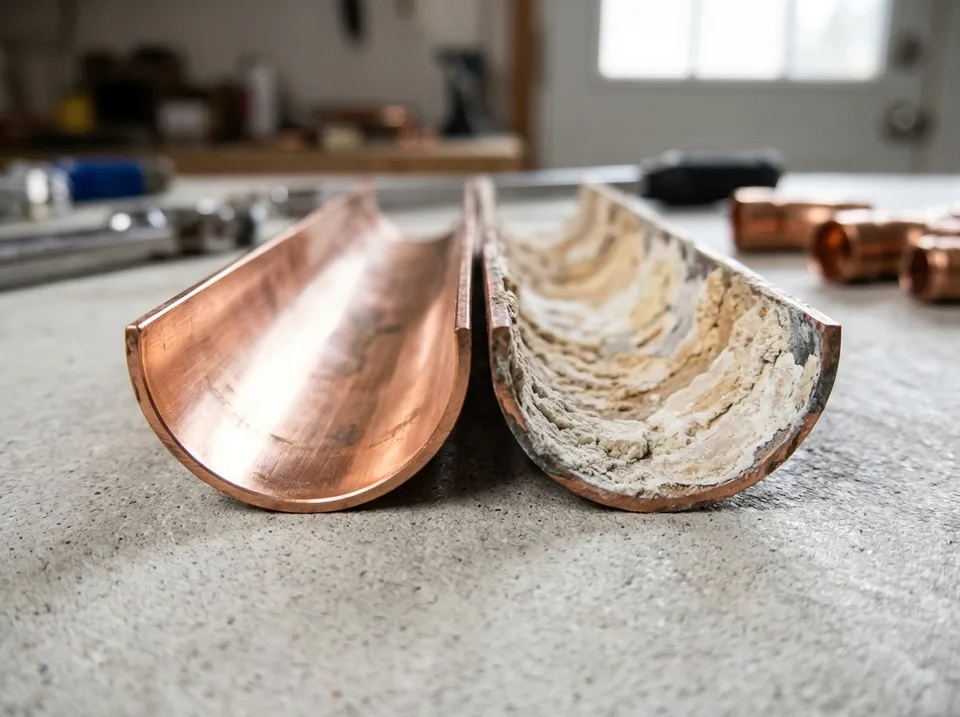
Condensation vs. Active Pinhole Leak Check
Separate fixture-specific issues from whole-home supply or water-heater symptoms using the 2 diagnostic branches below before replacing valves or appliances.
| Observation | Likely Root Cause | Recommended Next Step |
|---|---|---|
| Uniform beading along cold copper runs & toilet tank in humid weather | Pipe surface temperature sitting below basement/crawlspace dew point | Insulate cold runs with closed-cell foam & run basement dehumidifier |
| Localized green crusting or steady drop forming at one spot when taps stay idle | Active pinhole corrosion leak (often cuprosolvency or Type M thinning) | Dry spot with paper towel; check pH and inspect ASTM B88 pipe grade |
What Pressure and Water Chemistry Thresholds Apply?
Check measured household static water pressure, tap hardness GPG, and thermal operating cutoffs against the verified residential code and USGS engineering benchmarks below.
| Diagnostic Parameter | Verified Threshold / Value | Reference Basis |
|---|---|---|
| Typical Cold Main Groundwater | 50–60 °F incoming temperature | USGS Groundwater |
| Closed-Cell Pipe Sleeve | 1/2 in. to 3/4 in. wall foam insulation | IECC / IPC |
| Low-pH Copper Risk Threshold | pH < 6.5 accelerates copper pitting | EPA / ASTM B88 |
When Should You Escalate This Symptom to a Licensed Plumber?
Wipe dry to confirm no pinhole weeping; wrap cold lines in closed-cell foam insulation (1/2 in. or 3/4 in. wall) and check toilet anti-sweat mixing valve.
Watch for turquoise/blue-green mineral crust around beads—if water still forms after insulating and dehumidifying, inspect for a pinhole leak.
What Are the Key Questions and Answers?
Direct answers to common technical, regulatory, and sizing questions sourced from primary U.S. government and OEM documentation.
What data sources validate the thresholds in Are Wet or Sweating Cold-Water Pipes Normal in Summer??
TapAndPipe audits Are Wet or Sweating Cold-Water Pipes Normal in Summer? exclusively against official .gov extracts, state contractor boards, and OEM technical documentation. Verdict: Condensation on uninsulated cold pipes — Risk of subfloor rot & mold, not a pipe leak. Baseline: Pipe surface temperature below indoor dew point triggers condensation..
What safety boundaries apply before acting on Are Wet or Sweating Cold-Water Pipes Normal in Summer??
Do not troubleshoot active gas leaks, electrical flooding, or structural sewer collapses from online guides alone—isolate hazards safely first. Wipe dry to confirm no pinhole weeping; wrap cold lines in closed-cell foam insulation (1/2 in. or 3/4 in. wall) and check toilet anti-sweat mixing valve.
How do 10 CFR 430, EPA PFAS, and IPC pressure rules relate to Are Wet or Sweating Cold-Water Pipes Normal in Summer??
Applicable federal and model codes cover 10 CFR 430.32 fixture/heater efficiency, EPA 4.0 ppt PFAS rules, and IPC/UPC mechanical clearances.
How did Public Law 119-21 change 2026 plumbing rebates?
Federal 25C tax credits ceased for post-2025 installations under P.L. 119-21, leaving state energy office HEAR/HOMES rebates and utility bill credits.
When should a homeowner escalate Are Wet or Sweating Cold-Water Pipes Normal in Summer? to a state-licensed plumber?
Escalate whenever tasks involve fuel-gas piping, Category IV exhaust venting, 240V electrical circuits, main shutoff valves, or permitted sewer excavations.
Does TapAndPipe accept paid placements inside Are Wet or Sweating Cold-Water Pipes Normal in Summer??
No. All specifications, state benchmarks, and contractor lists derive strictly from official public records and OEM manuals with zero paid ranking boosts.
Sources
- ASTM B88 Copper Water Tube & ASME B1.20.1 Pipe Threads — ASTM International & ASME, ASTM B88 / F876 / ASME B1.20.1 (retrieved 2026-11-23)
- NOAA National Weather Service Active Alerts API (Freeze Warnings) — NOAA National Weather Service, Live CAP GeoJSON Feed (retrieved 2026-11-23)
- USDA Plant Hardiness Zone Map ZIP Code Extreme Minimum Temperatures — USDA ARS & Oregon State PRISM Climate Group, 2023 PHZM ZIP Table (retrieved 2026-11-23)
- International Plumbing Code (IPC) & International Fuel Gas Code (IFGC Table 402.4) — International Code Council (ICC), 2021 / 2024 IPC & IFGC (retrieved 2026-11-23)
- USGS Water Science School — Drip & Household Leak Volume Conversion (15,140 drops/gal) — U.S. Geological Survey, USGS Drip Calculator Method (retrieved 2026-11-23)