
Heat Pump (HPWH) vs. Standard Electric Water Heater Comparison
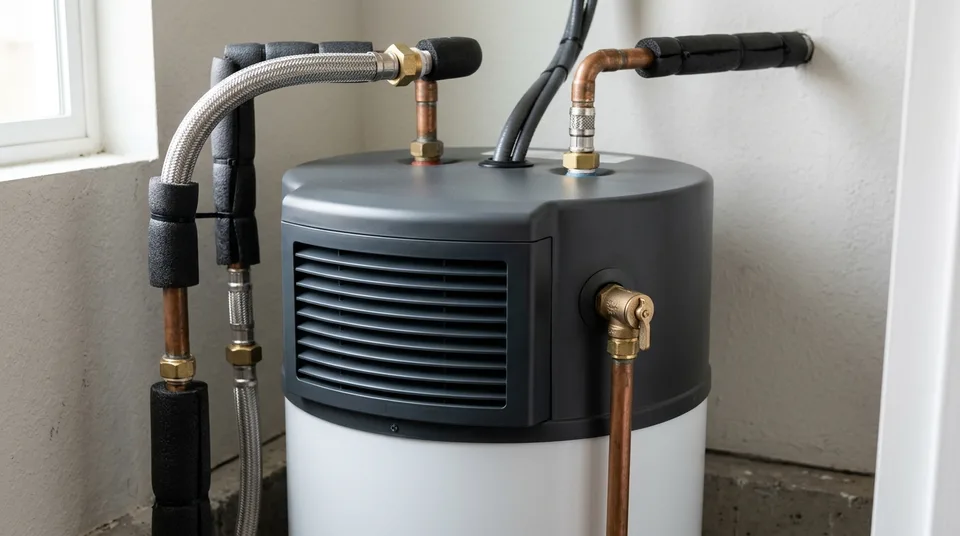
Hybrid heat pump water heaters achieve 3.30–4.05 UEF compared to 0.92 UEF on conventional electric resistance tanks, cutting electricity consumption by ~75% and clearing the May 6, 2029 federal DOE efficiency rule under 10 CFR 430.32(d)(2). At the August 2026 EIA US average residential rate of 18.16 cents/kWh, a 900 kWh/yr HPWH trims annual operating electricity spend by roughly $815/yr while remaining eligible for state DOE HEAR rebates up to $1,750.
- Option A
- Hybrid Heat Pump (HPWH)
- Option B
- Standard Electric Resistance
- Decision Criteria
- 6 Audited Metrics
- Governing Basis
- DOE 10 CFR 430.32(d)(2) & EIA
10-year utility math: using EIA August 2026 rates (18.16 ¢/kWh US avg; 47.18 ¢/kWh in HI; 24.51 ¢/kWh in CT), running a 900 kWh/yr HPWH costs $163/yr ($1,634 over 10 yrs) versus $979/yr ($9,788 over 10 yrs) for a 0.92 UEF resistance tank.
Incentive reality check: Federal IRC Section 25C expired December 31, 2025 under Public Law 119-21 (OBBBA). Remaining 2026 support flows through state DOE HEAR rebates (up to $1,750 for <=150% AMI households) and utility programs.
How Do Hybrid Heat Pump (HPWH) and Standard Electric Resistance Compare Metric by Metric?
This normalized comparison evaluates 6 primary technical criteria grounded in DOE 10 CFR 430.32(d)(2) & EIA, highlighting efficiency, code compliance, and retrofit constraints.
| Parameter | Hybrid Heat Pump (HPWH) | Standard Electric Resistance | Engineering Takeaway |
|---|---|---|---|
| Uniform Energy Factor | 3.30–4.05 UEF | 0.92–0.93 UEF | 3.5x–4.3x thermal efficiency gain |
| DOE May 6, 2029 Status | Compliant (exceeds 2.30–2.50 UEF) | Phased out (>35 to <=120 gal) | 10 CFR 430.32(d)(2) |
| Est. Annual Usage (50-gal) | ~850–1,050 kWh/yr | ~3,400–4,200 kWh/yr | ENERGY STAR certified vs 0.92 UEF |
| 10-Yr Spend @ EIA US Avg | ~$1,634 | ~$9,788 | Computed at 18.16 cents/kWh |
| 2026 Incentives | DOE HEAR (<= $1,750, <=150% AMI) | Not eligible (below 2029 tier) | Federal 25C expired 2025-12-31 |
| Room Air & Electrical | >=450–700 cu ft room; 240V or 120V | Compact closet; 240V 30A | Check 35–49 dBA compressor sound |
When Do Code and Field Conditions Favor Each Option?
Match your home's existing utility connections, ambient room air, tap water hardness, and local code cycle against the field selection criteria below before ordering equipment.
Choose Hybrid Heat Pump (HPWH) When:
- Garage, basement, or utility space with >=450 cu ft air volume
- High electric utility rates (EIA >= 18 cents/kWh)
- Income-eligible for state DOE HEAR or local utility rebate
Choose Standard Electric Resistance When:
- Tight interior closet <300 cu ft with zero ducting options
- Sub-35 gal point-of-use utility applications exempt from 2029 HPWH tier
What Are the Limitations of Hybrid Heat Pump (HPWH) vs. Standard Electric Resistance?
Neither Hybrid Heat Pump (HPWH) nor Standard Electric Resistance fits all existing mechanical spaces, gas lines, or municipal code zones.
Key Limitations & Exclusions
- 10-year utility math: using EIA August 2026 rates (18.16 ¢/kWh US avg; 47.18 ¢/kWh in HI; 24.51 ¢/kWh in CT), running a 900 kWh/yr HPWH costs $163/yr ($1,634 over 10 yrs) versus $979/yr ($9,788 over 10 yrs) for a 0.92 UEF resistance tank.
- Incentive reality check: Federal IRC Section 25C expired December 31, 2025 under Public Law 119-21 (OBBBA). Remaining 2026 support flows through state DOE HEAR rebates (up to $1,750 for <=150% AMI households) and utility programs.
- Verify local municipal amendments and physical rough-in clearances before purchasing.
Which Option Fits Your Situation?
What Are the Key Questions and Answers?
Direct answers to common technical, regulatory, and sizing questions sourced from primary U.S. government and OEM documentation.
How does TapAndPipe verify figures for Heat Pump (HPWH) vs. Standard Electric Water Heater Comparison?
Every metric on Heat Pump (HPWH) vs. Standard Electric Water Heater Comparison comes from primary U.S. government filings (10 CFR 430, BLS wages, EIA electric rates, EPA water records, USGS hardness) or OEM service manuals. Evaluates Hybrid Heat Pump (HPWH) against Standard Electric Resistance using DOE 10 CFR 430.32(d)(2) & EIA.
Who should NOT rely solely on online tables for Heat Pump (HPWH) vs. Standard Electric Water Heater Comparison?
Evacuate and call 911 immediately for any mercaptan gas odor, and never substitute reference tables for local permit inspections on 240V or gas manifolds. Confirm physical dimensions, fuel lines, and local AHJ permit requirements prior to installation.
What plumbing codes and federal rules apply in 2026 to Heat Pump (HPWH) vs. Standard Electric Water Heater Comparison?
Key guardrails include IPC §604.8 (80 psi static pressure ceiling), IFGC Table 402.4 gas sizing, EPA 4.0 ppt PFOA/PFOS limits, and May 6, 2029 10 CFR 430.32 water heater floors.
Are 2026 federal IRC Section 25C tax credits active for upgrades?
No. Public Law 119-21 (OBBBA) ended IRC Section 25C credits after December 31, 2025. Check state DOE HEAR rebates (up to $1,750 for <=150% AMI) and local utility incentives.
When should a homeowner escalate Heat Pump (HPWH) vs. Standard Electric Water Heater Comparison to a state-licensed plumber?
Escalate whenever tasks involve fuel-gas piping, Category IV exhaust venting, 240V electrical circuits, main shutoff valves, or permitted sewer excavations.
Does TapAndPipe accept paid placements inside Heat Pump (HPWH) vs. Standard Electric Water Heater Comparison?
No. All specifications, state benchmarks, and contractor lists derive strictly from official public records and OEM manuals with zero paid ranking boosts.
Sources
- 10 CFR 430.32 — Energy and Water Conservation Standards (Water Heaters & Plumbing Fixtures) — U.S. Department of Energy / eCFR, 2026 eCFR (incl. May 6, 2029 Rule) (retrieved 2026-11-23)
- ENERGY STAR Certified Water Heaters Dataset (Socrata pbpq-swnu) — U.S. EPA & DOE ENERGY STAR, 2026 Live Certified Registry (retrieved 2026-11-23)
- DOE Home Energy Rebates Programs (HEAR/HOMES) & OBBBA (P.L. 119-21) Status — U.S. Department of Energy, 2026 Program Guidance (retrieved 2026-11-23)
- EIA Electric Power Monthly Table 5.6.A — Average Residential Electricity Price by State — U.S. Energy Information Administration (EIA), August 2026 Monthly Release (retrieved 2026-11-23)