
How to Identify and Replace Moen, Delta, Kohler & Pfister Cartridges
Match single-handle shower and sink cartridges across 30 verified OEM platforms without removing the stem first by checking two mechanical cues: handle movement (pull-turn vs. rotate-only) and retainer hardware (vertical wire U-clip vs. threaded bonnet nut). Always shut off hot and cold isolation stops before pulling any clip—and remember Moen 1222, 1225, and M-CORE 1212 never interchange.
- OEM Assemblies Indexed
- 30 Platforms
- 1-Drip/Sec Waste
- 2,082+ gal/yr (USGS)
- Static Pressure Ceiling
- <= 80 psi (IPC §604.8)
- WaterSense Faucet Cap
- <= 1.5 GPM
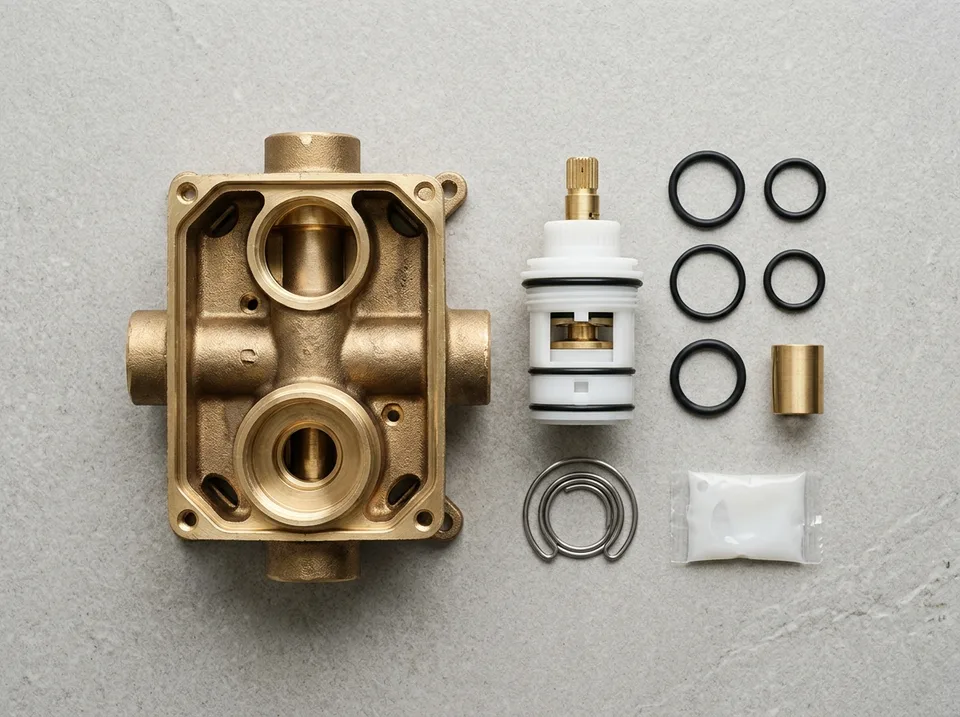
Pre-2006 vs. Post-2007 Delta split: Delta Monitor 1300/1400 (RP19804 white cap) and MultiChoice R10000 (RP46074 grey cap) look nearly identical externally but have incompatible leg lengths.
High pressure (>80 psi) shreds rubber seats and ceramic seals prematurely—check hose-bibb static PSI if new cartridges keep dripping.
How Do You Tell Moen 1222, 1225, 1255, and M-CORE Apart in 30 Seconds?
Pull-out handles belong to Moen 1225/1200 (wire U-clip); rotate-only handles with a U-clip are Moen 1222 Posi-Temp; kitchen/lavatory levers using a threaded collar nut are Moen 1255 Duralast; and new U140 rough-ins use M-CORE 1212/1213.
What Steps Prevent Seized Cartridge Extraction Damage?
Shut off both house or integral stops, open the valve to bleed 50–80 psi pressure, lubricate O-rings strictly with plumber's silicone grease (never petroleum Vaseline, which swells EPDM rubber), and use a brand-matched cartridge puller on brass Moen bodies.
When Does a Dripping Valve Require Full Rough-In Replacement Instead of a Cartridge?
Pitted brass valve seats inside 40+ year old shower bodies cause brand-new cartridges to keep dripping.
Key Limitations & Exclusions
- Never yank on a cartridge without removing the top wire U-clip or bonnet ring first.
- Never use petroleum jelly on EPDM cartridge seals or O-rings.
- If integral wall stops are frozen, shut off the main house valve before disassembling trim.
Which Option Fits Your Situation?
What Do Homeowners Ask Most About This Topic?
Direct answers to common technical, regulatory, and sizing questions sourced from primary U.S. government and OEM documentation.
Why does my toilet keep running?
A continuously running toilet almost always stems from a warped rubber flapper seal, a misaligned flush chain, or a fill-valve float set above the overflow tube rim. Because a 1-drop-per-second leak wastes 2,082+ gallons/year (15,140 drops/gal USGS), replacing the flapper or fill valve resolves most leaks.
How long should 40 pounds of salt last in a water softener?
Under USGS household water usage of 75 gallons per person daily at 10 GPG hardness, a four-person home needs roughly 3,000 grains of daily capacity, or 21,000 grains per week. At typical 8–10 lb salt usage per weekly regeneration, one 40 lb bag lasts about 4 to 5 weeks.
How big of a water softener do I need for a 3 bathroom house?
Size ion-exchange tanks by household occupants and measured USGS tap hardness rather than bathroom count alone. Multiply occupants by 75 gal/day and compensated hardness in GPG plus 4x clear-water iron ppm over a 7-day cycle; 3–4 residents at 10 GPG typically size into a 32,000-to-40,000-grain tank.
Can bacteria grow in a water softener brine tank?
High-salinity sodium chloride brine inhibits most microbial growth, though sediment, iron fouling, or stagnant water above the salt bridge can foster biofilm on tank walls. Cleaning the brine tank annually with mild non-chlorinated detergent or manufacturer-approved resin cleaner keeps the draw assembly sanitary.
Which state has the worst hard water?
Among states sampled in the USGS Water Quality Portal, California recorded 36.1 GPG median hardness across 4 high-mineral sampling sets, Ohio measured 15.6 GPG across 1,500 samples, Arizona measured 13.0 GPG across 173 samples, and Minnesota measured 12.5 GPG across 1,486 samples—all exceeding the 10.5 GPG Very Hard threshold.
Is hard water healthier for you?
Calcium and magnesium hardness ions above 7.0 GPG pose no federal health violation under EPA Safe Drinking Water Act rules, unlike 4.0 ppt PFAS or 10 ppb lead action levels. However, mineral scale coats tankless heat exchangers and tank heating elements, reducing thermal efficiency and shortening equipment service life.
Can I use 30% vinegar to flush my tankless water heater?
Standard OEM descaling manuals from Rinnai and Navien specify circulating 4 gallons of household 5% food-grade white vinegar or an NSF-approved descaling solution for 30 to 45 minutes. Undiluted 30% concentrated acetic acid can swell elastomeric O-rings and etch brass isolation valve components unless specifically diluted first.
How often should a tankless water heater be cleaned?
OEM manufacturers recommend flushing condensing and non-condensing tankless heat exchangers every 12 months when tap water reaches or exceeds 7.0 GPG USGS Hard classification, and every 6 months in Very Hard water above 10.5 GPG, alongside cleaning the cold-water inlet filter mesh screen.
Sources
- Moen Cartridge Identification & Posi-Temp Rough-In Valve Support Reference — Moen (Fortune Brands Innovations), Moen Support Parts Matrix (retrieved 2026-11-23)
- Delta Faucet MultiChoice Universal Valve & Cartridge Compatibility Guide — Delta Faucet Company (Masco), Delta MultiChoice R10000 Tech Sheet (retrieved 2026-11-23)
- Kohler Rite-Temp Pressure-Balancing Valve & Toilet Flush Valve Specifications — Kohler Co., Kohler Service Parts Portal (retrieved 2026-11-23)
- Pfister, Grohe & American Standard Ceramic Disc Cartridge & Flush Valve Specifications — Pfister / Grohe / LIXIL American Standard, 2026 OEM Replacement Parts Matrix (retrieved 2026-11-25)
- USGS Water Science School — Drip & Household Leak Volume Conversion (15,140 drops/gal) — U.S. Geological Survey, USGS Drip Calculator Method (retrieved 2026-11-23)