
How to Flush and Descale a Tankless Water Heater Safely
Flushing a condensing or non-condensing tankless water heater once every 12 months (or every 6 months above 10.5 GPG USGS Very Hard tap water) clears calcium carbonate scale off copper and stainless heat exchanger fins in 30 to 45 minutes. Standard OEM procedures from Rinnai and Navien circulate 4 gallons of household 5% food-grade white vinegar through brass service isolation valves—warning against undiluted 30% industrial vinegar that can degrade rubber O-rings and pump seals.
- Standard Acid Grade
- 5% White Vinegar (4 gal)
- Circulation Time
- 30–45 Minutes
- Hard Water Interval
- Every 12 mos (>=7.0 GPG)
- 30% Vinegar Warning
- Dilute or Avoid (Seals)
- Tankless Lifespan
- 15–20 Years w/ Descaling
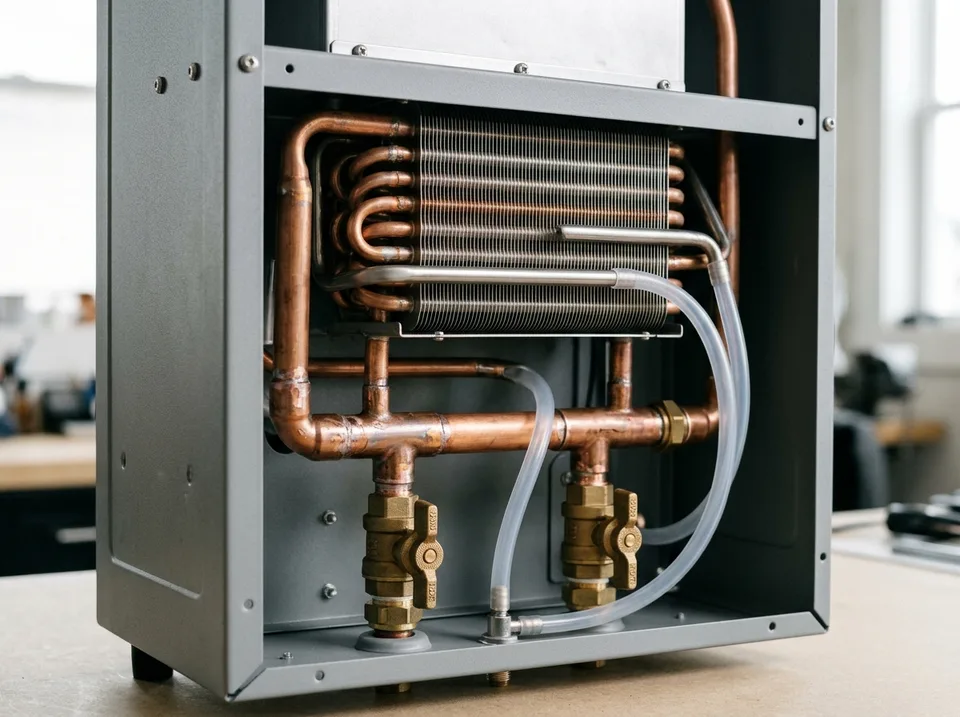
30% vinegar warning: concentrated 30% horticultural/industrial acetic acid is 6x stronger than 5% kitchen vinegar and can corrode brass check valves or EPDM seals if circulated undiluted.
Inlet filter check: always unscrew and rinse the cold-water inlet mesh screen during the flush, since trapped sediment triggers flow-turbine errors even on clean exchangers.
How Do You Flush a Tankless Water Heater Step by Step?
Isolate gas/120V power and shut both hot and cold brass service isolation valves before connecting washing-machine hoses to a 1/6 HP submersible sump pump inside a 5-gallon bucket holding 4 gallons of 5% white vinegar.
Turn off 120V power and gas cock; rotate hot and cold isolation ball valves 90 degrees perpendicular to close.
Open service purge caps, hook hoses from pump through cold port out hot port, and circulate 4 gal 5% white vinegar.
Discard vinegar, flush 3–5 gal cold city water out the hot drain hose, clean inlet mesh filter, and restore valves.
Should You Flush a 10-Year-Old Tankless vs. Storage Tank Water Heater?
A 10-year-old condensing gas tankless water heater with functioning brass isolation valves still benefits directly from annual 5% vinegar descaling toward its 15–20 year exchanger life. By contrast, avoid violently flushing a neglected 10-year-old steel storage tank because dislodged sediment plugs sometimes expose bottom rust leaks.
Who Should Not Flush a Tankless Water Heater Without Isolation Valves?
DIY descaling requires intact brass purge valves; older installations lacking service tees or leaking at union threads require licensed plumbing service.
Key Limitations & Exclusions
- Do not attempt circulation flushing if your unit was installed without hot/cold brass isolation purge valves.
- Never circulate undiluted 30% industrial acetic acid or muriatic acid—excess acidity damages internal bronze pumps and seals.
- Skip DIY flushing if you smell mercaptan gas or observe corrosion trails inside the sealed burner cabinet.
Which Option Fits Your Situation?
What Do Homeowners Ask Most About This Topic?
Direct answers to common technical, regulatory, and sizing questions sourced from primary U.S. government and OEM documentation.
Can I use 30% vinegar to flush my tankless water heater?
Standard OEM descaling manuals from Rinnai and Navien specify circulating 4 gallons of household 5% food-grade white vinegar or an NSF-approved descaling solution for 30 to 45 minutes. Undiluted 30% concentrated acetic acid can swell elastomeric O-rings and etch brass isolation valve components unless specifically diluted first.
How often should a tankless water heater be cleaned?
OEM manufacturers recommend flushing condensing and non-condensing tankless heat exchangers every 12 months when tap water reaches or exceeds 7.0 GPG USGS Hard classification, and every 6 months in Very Hard water above 10.5 GPG, alongside cleaning the cold-water inlet filter mesh screen.
Should you flush a 10 year old water heater?
Exercise caution before aggressively flushing an unmaintained 10-year-old storage tank water heater, because calcified sediment may already be sealing hairline corrosion pinholes along the bottom seam. Decode your serial number age first; storage tanks average 8–12 years, whereas a 10-year-old tankless exchanger with clean brass valves still benefits from annual descaling.
Why are plumbers against tankless water heaters?
Field plumbers flag tank-to-tankless retrofits mainly when homeowners expect a drop-in swap. A 199,000 BTU/h gas tankless unit often exceeds existing 1/2 in. Sch 40 gas capacity beyond 10 ft under IFGC Table 402.4, requires Category IV PVC venting, and needs annual descaling in hard water above 7.0 GPG.
How big of a tankless water heater do I need to replace a 40 gallon water heater?
Size replacement tankless units by peak simultaneous GPM flow and incoming winter groundwater temperature rise rather than gallon count. Two concurrent 2.0 GPM showers plus a kitchen tap demand 5.0–6.0 GPM; at 50 °F incoming water heated to 120 °F, that requires 175,000–199,000 BTU/h gas or 27–36 kW electric.
What size tankless water heater for 3 bedroom 2 bath house?
A 3-bedroom, 2-bath residence running two simultaneous 2.0 GPM showers and a dishwasher typically requires 5.5–7.5 GPM output at a 60–70 °F temperature rise. That matches a 180,000–199,000 BTU/h condensing gas unit (0.91–0.96 UEF) or a 27–36 kW 240V electric model requiring 112–150 amps.
What is the most common problem with tankless water heaters?
Ignition lockouts such as Rinnai 11 and Navien E003 during peak demand are the leading installation fault, commonly caused by undersized 1/2 in. gas piping unable to carry 199 CFH under IFGC Table 402.4. In service, mineral scale buildup above 7.0 GPG hardness and dirty flame sensors rank next.
What's the average lifespan of a water heater?
Standard atmospheric gas and electric resistance storage tanks average 8 to 12 years, depending on tap water hardness and 4-to-6-year sacrificial anode rod replacement. Condensing gas tankless heat exchangers average 15 to 20 years when flushed annually and kept free of calcium scale.
Sources
- Rinnai Tankless Water Heater Diagnostic Error Codes & Installation Specifications — Rinnai America Corporation, Sensei / Residential Tankless Service Manual (retrieved 2026-11-23)
- Navien NPE-A2 / NCB-H Condensing Tankless Error Codes & Gas Line Manual — Navien Inc., NPE-2 Series Installation & Operation Manual (retrieved 2026-11-23)
- National Water Quality Monitoring Council Water Quality Portal (Hardness, Ca, Mg) — USGS & U.S. EPA, WQP Result Service (retrieved 2026-11-23)
- A. O. Smith Residential Water Heater Serial Number & Diagnostics Documentation — A. O. Smith Corporation, OEM Technical Bulletins (retrieved 2026-11-23)