
Rinnai REHP65W* Water Heater Specifications (4 UEF)
Engineered as a Electric Hybrid/Electric Heat Pump unit, Rinnai REHP65W* achieves a certified 4.0 UEF rating across its 61-gallon nominal tank, 80 gal First Hour Rating and ranks #106 of 706 in its 706-model cohort (PD 4682177), recording Pass: +1.50 / +60.0% under 2029 DOE rules. Rated annual electricity draw of 1,234 kWh/yr equates to roughly $224/yr ($2,241 over 10 years) at 18.16 cents/kWh. Closest certified alternative is Midea CAN3-RSJ-15/250RDVN3-L4 (4.0 UEF).
- Uniform Energy Factor
- 4.0 UEF
- Cohort UEF Rank
- #106 of 706 (top 19.8%)
- First Hour Rating
- 80 gal
- Storage Volume
- 61 gal
- Fuel / Type
- Electric / Hybrid/Electric Heat Pump
- DOE 2029 Rule Status
- Pass: +1.50 / +60.0%
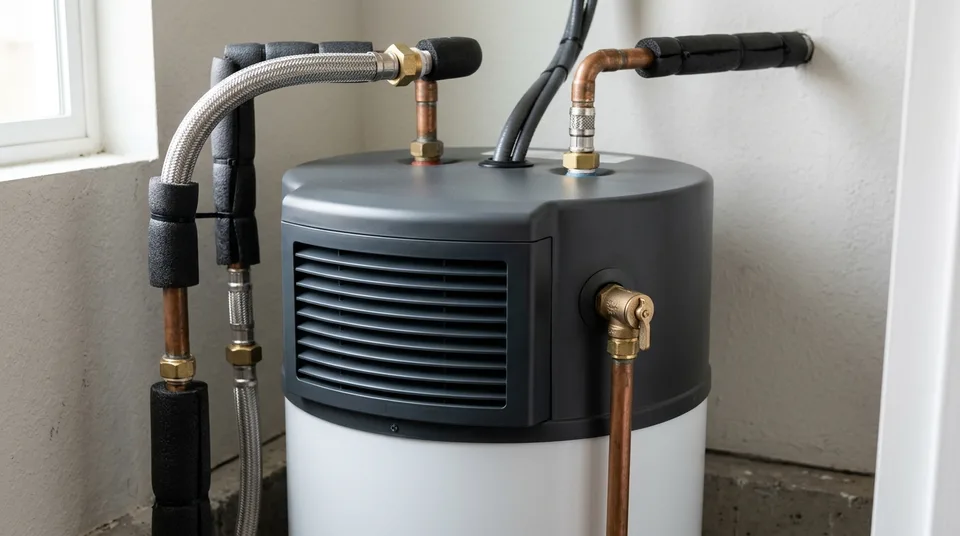
Within the 706-unit Hybrid/Electric Heat Pump cohort, Rinnai REHP65W* logs 4.0 UEF and ranks #106 of 706.
Against 10 CFR 430.32(d)(2) Electric >55 to <=120 gal (2.50 UEF), Rinnai REHP65W* holds a +1.50 UEF (+60.0%) compliance cushion. At EIA August 2026 national rates (18.16 cents/kWh), 1,234 kWh/yr for Rinnai REHP65W* runs ~$224/yr vs. ~$974/yr for a 0.92 UEF electric tank. Acoustic output is 49 dBA (quieter than 12.8% of Hybrid/Electric Heat Pump models).
State electric sensitivity for Rinnai REHP65W*: 10-year operating spend spans $1,805 in Washington (Lowest Hydro Tier) (14.63 cents/kWh) to $5,822 in Hawaii (Highest EIA State) (47.18 cents/kWh).
Cross-shopping Rinnai REHP65W* (4.0 UEF)? Check Midea CAN3-RSJ-15/250RDVN3-L4 (4.0 UEF, at parity) and Navien NWP500S065AUMB (4.03 UEF, delta +0.03).
Where Does Rinnai REHP65W* Rank Against Peer Hybrid/Electric Heat Pump Units?
Audited against 706 ENERGY STAR Hybrid/Electric Heat Pump listings, Rinnai REHP65W* holds #106 of 706 (top 19.8%); inspect footprint, circuit load, and efficiency deltas here.
| Specification Attribute | Certified Value | Cohort Benchmark / Delta | Provenance |
|---|---|---|---|
| Manufacturer / Brand | Rinnai | 25 certified listings | ENERGY STAR PD 4682177 |
| Model Number | REHP65W* | Draw pattern: High-Usage | REHP65W* |
| Uniform Energy Factor (UEF) | 4.0 | +0.30 UEF vs. 3.70 UEF median | 10 CFR 430 Test Method |
| First Hour Rating (FHR) | 80 gal | +8 gal vs. 72 gal median | 10 CFR 430 Recovery Test |
| Rated Annual Electricity Use | 1,234 kWh/yr | +162 kWh/yr vs. 1,072 kWh/yr median | Est. $224/yr @ $0.1816/kWh (EIA US Avg) |
| Thermal Recovery Efficiency | 450% | +21.0 pts vs. 429.0% median | ENERGY STAR Dataset |
| Physical Envelope (H x Dia) | 45.5" H x 21.8" D | Fits standard 72 in. basement/garage clearance; clears 28 in. utility doorway (21.8" D) | Doorway & ceiling check |
| Electrical Circuit Requirements | 240 V / 24 A max | Requires 240V dedicated branch circuit; check panel capacity | NEC / Branch circuit check |
| Heat Pump Refrigerant & GWP | R-134a (GWP:1430) | Check regional AIM Act phase-down transition | EPA AIM Act Compliance |
| Sound Pressure Level | 49 dBA | quieter than 12.8% of Hybrid/Electric Heat Pump models · At 49 dBA median | Indoor placement check |
| Certification Date | 2026-07-31 | Certified 2026-07-31 | Markets: United States, Canada |
How Much Electricity Does REHP65W* Use in Different States?
Estimated at $224/yr nationally (1,234 kWh/yr), 10-year utility spending for Rinnai REHP65W* shifts sharply between low-rate hydro and coastal grids.
| Jurisdiction (EIA Aug 2026) | Residential Rate | Annual Cost | 10-Yr Operating Spend | 10-Yr Savings vs. 0.92 UEF |
|---|---|---|---|---|
| United States Average | 18.16 ¢/kWh ($0.1816) | $224/yr | $2,241 | $7,502 |
| Hawaii (Highest EIA State) | 47.18 ¢/kWh ($0.4718) | $582/yr | $5,822 | $19,490 |
| California | 29.75 ¢/kWh ($0.2975) | $367/yr | $3,671 | $12,290 |
| Texas | 15.91 ¢/kWh ($0.1591) | $196/yr | $1,963 | $6,572 |
| Washington (Lowest Hydro Tier) | 14.63 ¢/kWh ($0.1463) | $181/yr | $1,805 | $6,044 |
Does CPSC Flag Any Safety Notices on Rinnai Units?
No open CPSC recall alerts appeared for Rinnai as of 2026-11-23; you can still decode exact manufacture month and warranty window below. See Serial Number Lookup.
Which Competing Hybrid/Electric Heat Pump Models Compare Closest to REHP65W*?
Compare five nearby ENERGY STAR Hybrid/Electric Heat Pump options matched closely to Rinnai REHP65W*'s gallon capacity and 4.0 UEF efficiency.
| Brand & Model | Type | Vol | FHR | UEF (Δ) | kWh/yr |
|---|---|---|---|---|---|
| Midea CAN3-RSJ-15/250RDVN3-L4 | Hybrid/Electric Heat Pump | 61 gal | 80 gal | 4.0 (at parity) | 1,234 |
| Navien NWP500S065AUMB | Hybrid/Electric Heat Pump | 61 gal | 80 gal | 4.03 (+0.03) | 1,245 |
| Ariston ARIHPWH-65-T | Hybrid/Electric Heat Pump | 61 gal | 77 gal | 4.05 (+0.05) | 1,225 |
| Lennox WHHP065T45MD240S**** | Hybrid/Electric Heat Pump | 61 gal | 77 gal | 4.05 (+0.05) | 1,225 |
| Midea MAHW-65VN3B | Hybrid/Electric Heat Pump | 61 gal | 80 gal | 4.0 (at parity) | 1,234 |
What Installation Caveats Apply Before Buying Rinnai REHP65W*?
Even high-UEF units like Rinnai REHP65W* (4.0 UEF) carry physical space, condensate, and fuel-line prerequisites noted below.
Key Limitations & Exclusions
- Rinnai REHP65W* needs >=450 cu ft room air volume or ducting so compressor cooling does not stall recovery.
- Compressor runs near 49 dBA; avoid mounting Rinnai REHP65W* directly beside quiet bedrooms.
- Requires condensate drain routing and 240V electrical capacity; verify state DOE HEAR status.
Which Option Fits Your Situation?
Common Homeowner Questions for Rinnai REHP65W*
Direct answers to common technical, regulatory, and sizing questions sourced from primary U.S. government and OEM documentation.
Is Rinnai REHP65W* eligible for continued manufacture past May 6, 2029?
At 4.0 UEF, Rinnai REHP65W* achieves Pass: +1.50 / +60.0% for the 2029 DOE standard and stands #106 of 706 (top 19.8%) against Midea CAN3-RSJ-15/250RDVN3-L4 and Navien NWP500S065AUMB.
How tall and wide is Rinnai REHP65W*, and what service clearance is needed?
Physical dimensions for Rinnai REHP65W* are 45.5 in. height and 21.8 in. diameter (fits standard 72 in. basement/garage clearance; clears 28 in. utility doorway (21.8" d)); verify stair turns and drain pan width before delivery.
Will Rinnai REHP65W* require upgrading household electrical panels or gas piping?
Rinnai REHP65W* draws 240V at 24A max (Requires 240V dedicated branch circuit; check panel capacity); check whether existing 10/2 AWG 30A copper wiring aligns with nameplate amps.
Is Rinnai REHP65W* economical to operate at 18.16 cents/kWh US electric rates?
Expect roughly $224/yr ($2,240 over 10 years) to power Rinnai REHP65W* at 1,234 kWh/yr under the 18.16 cents/kWh US average (ranging from $181/yr in Washington hydro tiers up to $582/yr in Hawaii).
Which installation bottlenecks limit Rinnai REHP65W*?
If ambient room air stays below 40 °F year-round or closet volume falls under 450 cu ft, Rinnai REHP65W* drops into resistance mode more often.
How does Rinnai REHP65W* handle simultaneous showers and laundry?
Delivering 80 gal in the first hour (+8 gal vs. 72 gal median), Rinnai REHP65W* combines 61 gal tank storage with rapid burner/element recovery.
How long is the warranty on Rinnai REHP65W* and how do you decode its serial?
CPSC records show 0 active plumbing recalls for Rinnai as of 2026-11-23. Confirm install proof and serial manufacture year on Rinnai REHP65W* before calling service.
How do 2026 post-OBBBA rebates affect buying Rinnai REHP65W*?
Check state energy office HEAR portals and utility rebates in 2026 since federal 25C ended Dec 31, 2025. Closest peer in Hybrid/Electric Heat Pump is Midea CAN3-RSJ-15/250RDVN3-L4 (4.0 UEF).
Sources
- ENERGY STAR Certified Water Heaters Dataset (Socrata pbpq-swnu) — U.S. EPA & DOE ENERGY STAR, 2026 Live Certified Registry (retrieved 2026-11-23)
- 10 CFR 430.32 — Energy and Water Conservation Standards (Water Heaters & Plumbing Fixtures) — U.S. Department of Energy / eCFR, 2026 eCFR (incl. May 6, 2029 Rule) (retrieved 2026-11-23)
- CPSC SaferProducts.gov Product Recalls REST API — U.S. Consumer Product Safety Commission, 2026 Live Recalls Feed (retrieved 2026-11-23)
- EIA Electric Power Monthly Table 5.6.A — Average Residential Electricity Price by State — U.S. Energy Information Administration (EIA), August 2026 Monthly Release (retrieved 2026-11-23)