
Water Heater T&P Relief Valve Discharging Hot Water
A discharging Temperature & Pressure relief valve indicates either harmless thermal expansion spikes above 150 psi (failed expansion tank) or dangerous overheating near 210 °F. Follow all three isolation steps in sequence during the 0–15 minute containment window before calling a state-licensed plumber. Every figure is checked against official U.S. government records, model energy code tables, or manufacturer service manuals with no fake reviews or paid rankings.
- Urgency Tier
- Thermal Expansion vs. Over-Temp Check
- Gas 911 Gate
- Water / Power Isolation
- Target Response
- 0–15 Minutes
- Static Pressure Cap
- ≤ 80 psi (IPC §604.8)
How Do You Isolate Water Heater T&P Relief Valve Discharging Hot Water in 3 Immediate Steps?
Execute this 0–15 minute containment sequence in strict order to halt active water discharge, eliminate electrical shock or ignition risks, and document conditions before licensed repair arrives.
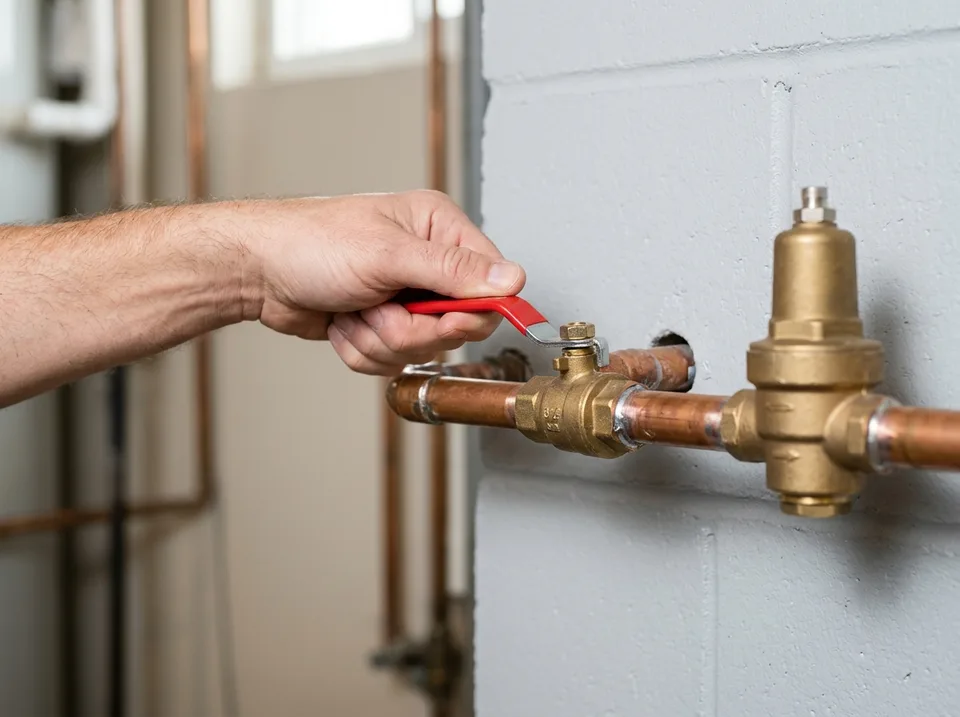
Do NOT cap, plug, or thread a stopper onto a dripping Temperature & Pressure (T&P) relief discharge pipe — sealing a T&P valve creates an explosive pressure-vessel hazard.
Turn the thermostat down to 120 °F and verify if discharge occurs immediately after water-heating cycles (failed bladder in thermal expansion tank) or continuously (excess static pressure >80 psi or stuck thermostat).
If hot steam or >190 °F water vents, shut down gas/electric power and cold inlet immediately and call a licensed plumber.
What Are the Verified Safety and Code Thresholds?
Review physical pressure, thermal relief, and residential code limits governing Water Heater T&P Relief Valve Discharging Hot Water, sourced from IPC, NFPA 54, and USDA freeze benchmarks.
| Parameter | Verified Standard |
|---|---|
| Standard T&P set pressure / temp | 150 psi / 210 °F ASME-rated relief threshold |
| Maximum static pressure limit | 80 psi residential limit (IPC §604.8; requires thermal expansion control) |
| Over-temp gas valve error | 4 flashes on Honeywell/A.O. Smith gas valves (ECO limit) |
| Static Residential Supply Limit | 80 psi max (IPC §604.8 PRV ceiling) |
| T&P Relief Valve Calibration | 150 psi / 210 deg F automatic discharge |
Which Other Emergency Isolation Playbooks Apply?
Switch to any adjacent emergency playbook below if multiple fixtures, fuel odors, or drain backups occur simultaneously across your home.
| Scenario | Urgency | First Shutoff Action |
|---|---|---|
| Burst or Frozen Water Pipe Shutoff & Triage | 0-15 Minutes Critical Water Shutoff | Close the main house shutoff valve perpendicular to the pipe |
| Natural Gas or Propane Smell Near Water Heater | IMMEDIATE EVACUATION — CALL 911 & GAS UTILITY | Evacuate immediately without operating switches and call 911 outside |
| Water Heater Tank Leaking From Base or Jacket | 0-15 Minutes Isolation & Tank Drain | Close cold-water inlet valve above the tank and cut gas/240V power |
| Main Sewer Line Backup (Lowest Drain Overflowing) | Stop All Water Use & Isolate Cleanout | Halt all toilets, washers, and sinks; inspect exterior cleanout |
| Basement Sump Pump Stuck or Overflowing | Electrical GFCI Check & Discharge Line Clearing | Check GFCI/breaker safely without stepping in standing water |
What Are the Key Questions and Answers?
Direct answers to common technical, regulatory, and sizing questions sourced from primary U.S. government and OEM documentation.
What is the first shutoff step for Water Heater T&P Relief Valve Discharging Hot Water?
Do NOT cap, plug, or thread a stopper onto a dripping Temperature & Pressure (T&P) relief discharge pipe — sealing a T&P valve creates an explosive pressure-vessel hazard. Next: Turn the thermostat down to 120 °F and verify if discharge occurs immediately after water-heating cycles (failed bladder in thermal expansion tank) or continuously (excess static pressure >80 psi or stuck thermostat).
What verification step finishes Water Heater T&P Relief Valve Discharging Hot Water isolation?
If hot steam or >190 °F water vents, shut down gas/electric power and cold inlet immediately and call a licensed plumber. Standard residential thresholds remain <= 80 psi supply pressure (IPC §604.8) and 150 psi / 210 °F relief limits.
When does Water Heater T&P Relief Valve Discharging Hot Water require calling 911 vs. a licensed plumber?
Call 911 immediately from outdoors whenever natural gas or propane odor, carbon monoxide alarm, or electrical arcing occurs; otherwise isolate main valves and book a state-licensed contractor.
Where do the engineering metrics for Water Heater T&P Relief Valve Discharging Hot Water originate?
Data provenance for Water Heater T&P Relief Valve Discharging Hot Water links straight to verified agency releases and OEM installation bulletins. Urgency tier: Thermal Expansion vs. Over-Temp Check.
When should homeowners stop and call 911 or a pro on Water Heater T&P Relief Valve Discharging Hot Water?
Online tables clarify baseline engineering limits, not site-specific hazards like live gas odors or corroded service mains. Always call 911 from outside upon detecting gas odors and kill electrical breakers before standing in water.
Which federal regulatory baselines intersect with Water Heater T&P Relief Valve Discharging Hot Water?
Check local Authority Having Jurisdiction amendments to IPC/UPC codes alongside federal EPA drinking water and 10 CFR 430 efficiency mandates.
Which incentives remain open in 2026 for plumbing equipment?
Verify active state DOE HEAR allocations (up to $1,750 for heat pump water heaters) and local utility rebates following the Dec 31, 2025 25C expiration.
When should a homeowner escalate Water Heater T&P Relief Valve Discharging Hot Water to a state-licensed plumber?
Escalate whenever tasks involve fuel-gas piping, Category IV exhaust venting, 240V electrical circuits, main shutoff valves, or permitted sewer excavations.
Sources
- International Plumbing Code (IPC) & International Fuel Gas Code (IFGC Table 402.4) — International Code Council (ICC), 2021 / 2024 IPC & IFGC (retrieved 2026-11-23)
- A. O. Smith Residential Water Heater Serial Number & Diagnostics Documentation — A. O. Smith Corporation, OEM Technical Bulletins (retrieved 2026-11-23)