
PEX-A vs. Type L Copper Pipe: Engineering Specs, Freeze & Repipe Guide
Both ASTM B88 Type L copper (0.785 in. ID on 3/4 in. CTS) and ASTM F876/F1960 cold-expansion PEX-a (0.671 in. ID) handle 80 psi residential supply cleanly, yet material pricing and wall labor split sharply. Whole-house repipes replacing 1978–1995 Polybutylene or pre-1960 galvanized pipe average 18–42 BLS labor hours ($29.98/hr base median), with PEX-a expansion cutting fitting joints and dry-wall openings significantly.
- 3/4 in. Type L Copper ID
- 0.785 in. (ASTM B88)
- 3/4 in. PEX-a Pipe ID
- 0.671 in. (ASTM F876)
- Max Velocity (Hot Copper)
- ~5 ft/sec Erosion Cap
- Repipe Labor Hours
- 18–42 hrs (BLS 47-2152)
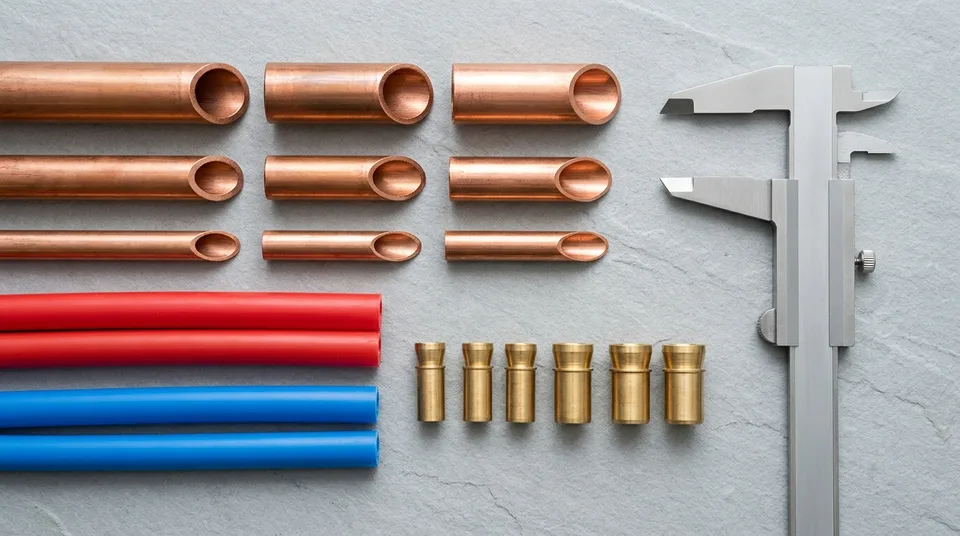
Acidic water rule: where well or municipal water sits below 6.5 pH (blue-green sink stains), copper experiences pinhole pitting—PEX-a is immune to cuprosolvency.
Never expose PEX-a to continuous UV sunlight or within 18 in. of an atmospheric gas water heater single-wall flue.
Why Does 3/4 in. PEX-a Carry Slightly Less Flow Than 3/4 in. Copper?
Because PEX-a has a thicker polymer wall under the identical 0.875 in. CTS outside diameter, its internal bore area is 0.354 sq in. vs. 0.484 sq in. for Type L copper—roughly 27% less cross-sectional area, making 1 in. PEX-a trunk mains smart for 3+ bath homes.
When Is Copper Mandatory Over PEX-a?
Exposed water heater stubs (first 18 inches above atmospheric flues), exterior UV-exposed hose drops, and select municipal codes like Chicago still require rigid ASTM B88 Type L or Type K copper.
When Should You Choose Type L Copper Instead of PEX-a (or Vice Versa)?
Each piping platform has clear chemical, UV, and local code boundaries.
Key Limitations & Exclusions
- PEX-a degrades under direct UV sunlight and must stay 18 in. clear of hot gas heater exhaust flues.
- Type L/M copper suffers pinhole pitting in low-pH (<6.5) water or >5 ft/sec hot recirculation loops.
- Pre-1995 Polybutylene (grey plastic) requires full repiping; use SharkBite U4008LF only for emergency transitions.
Which Option Fits Your Situation?
What Do Homeowners Ask Most About This Topic?
Direct answers to common technical, regulatory, and sizing questions sourced from primary U.S. government and OEM documentation.
How much for a plumber for 3 hours?
Using May 2024 U.S. Bureau of Labor Statistics employee wage data ($29.98/hr national state median pay), 3 hours of employee base pay equal $90. Applying a typical 1.85x licensed contractor truck, insurance, and overhead multiplier puts estimated 3-hour billed labor near $166 before parts or permits.
How much does a plumber charge for 4 hours of work?
At the May 2024 U.S. Bureau of Labor Statistics national state median employee wage of $29.98/hr, 4 hours of base pay total $120. Modeling standard 1.85x licensed contractor overhead puts 4 hours of billed residential labor near $222, rising in high-wage states like Illinois, Massachusetts, California, and Washington.
Are 24 hour plumbers more expensive?
Yes. May 2024 U.S. Bureau of Labor Statistics wages measure straight-time employee pay rather than contractor dispatch rates; emergency nights, weekends, and holiday calls typically add after-hours dispatch fees and overtime labor multipliers on top of daytime service rates to cover on-call truck readiness.
What questions should I ask a plumber?
Confirm their active state plumbing license number (such as Texas TSBPE RMP or state board ID), verify general liability and workers' compensation certificates, ask whether municipal permits and inspection fees are itemized in writing, and confirm flat-rate versus hourly overtime billing before work starts.
How do I find a good plumber?
Verify active state licensing standing directly on your state plumbing board portal rather than relying solely on star-rating ads. Request 2 to 3 written itemized scopes specifying permit numbers, ASME/IPC material grades (such as Type L copper vs. F1960 PEX-A), and disposal of old equipment.
What is a temporary fix for a hole in a pipe?
First close the main quarter-turn shutoff valve perpendicular to the pipe and open the lowest cold tap to bleed 50–80 psi line pressure. For minor pinhole weeping until a licensed plumber replaces the damaged section, clamp an EPDM rubber sleeve with stainless steel hose clamps or install an ASME-rated push-fit coupling.
What are the two types of plumbing?
Residential plumbing splits into two distinct pressurized and gravity networks: potable water supply and distribution piping (operating under 40–80 psi pressure under IPC Chapter 6) and Drain-Waste-Vent (DWV) sanitary gravity piping sloped at 1/8 to 1/4 in. per foot under IPC Chapter 7.
Can a plumber make $100,000 a year?
Yes. While May 2024 U.S. Bureau of Labor Statistics figures place the national state median employee plumber wage at $29.98/hr ($62,358/yr full-time), 90th-percentile experienced plumbers in unionized and coastal states (MA, IL, CA, WA, NY, NJ) earn $49 to $65+ per hour, exceeding $100,000 annually before overtime.
Sources
- ASTM B88 Copper Water Tube & ASME B1.20.1 Pipe Threads — ASTM International & ASME, ASTM B88 / F876 / ASME B1.20.1 (retrieved 2026-11-23)
- Zurn Backflow, Uponor PEX-a Expansion & SharkBite Push-to-Connect Insertion Specs — Zurn Elkay / Uponor / Reliance Worldwide Corp (SharkBite), 2026 OEM Installation Specifications (retrieved 2026-11-23)
- OEWS State Employment & Wage Estimates — SOC 47-2152 Plumbers, Pipefitters, and Steamfitters — U.S. Bureau of Labor Statistics, May 2024 OEWS (retrieved 2026-11-23)
- Lead and Copper Rule Improvements (LCRI) & Service Line Inventories — U.S. Environmental Protection Agency, 40 CFR Part 141 Subpart I (retrieved 2026-11-23)