
How to Thaw Frozen Plumbing Pipes Safely Without Splitting Joints
Uninsulated supply pipes freeze and burst when sustained temperatures drop to <=20 °F, expanding ice plugs against closed faucets until copper or CPVC splits. Before applying controlled warmth with a hair dryer, heat gun, or UL-listed heat cable, open the affected faucet, locate your main shutoff valve, and never use an open-flame propane torch near framing. Every benchmark on this page cites primary U.S. government data, IPC/UPC section standards, or official OEM manuals without sponsored rankings.
- Freeze Burst Exposure
- <= 20 °F Sustained
- Water Volume / Burst
- 8–12 GPM @ 50–80 psi
- Open-Flame Torches
- PROHIBITED (Fire Risk)
- Safe Thaw Direction
- Faucet Back to Freeze
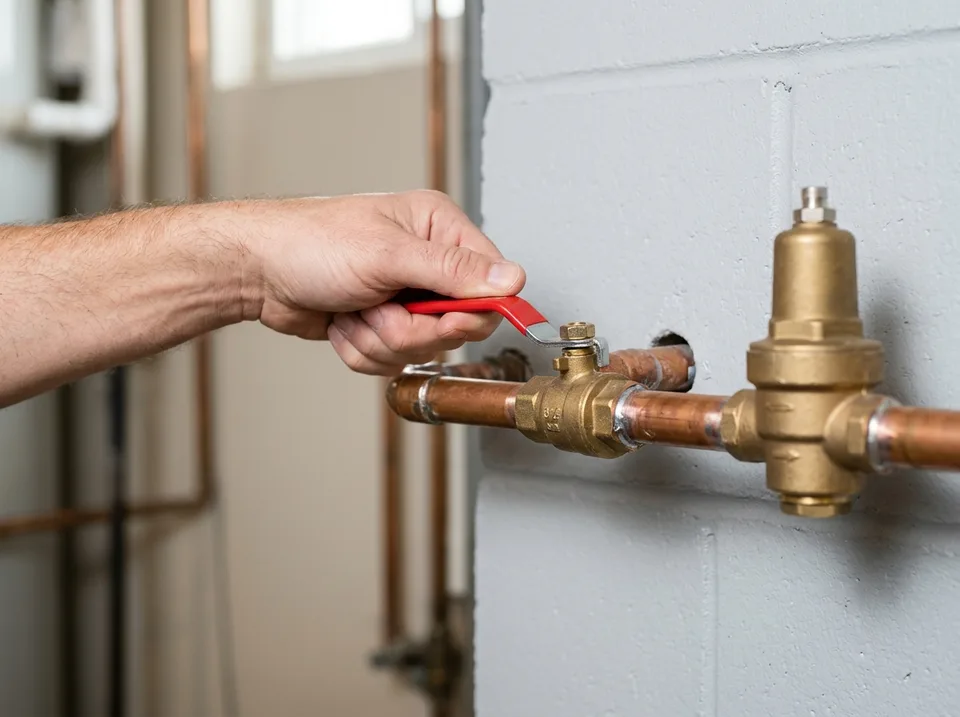
Always thaw from the open faucet backward toward the frozen plug so expanding steam and meltwater escape out the open spout instead of bursting behind the ice dam.
Keep the main quarter-turn shutoff location marked so anyone in the home can close water immediately if thawing uncovers a split.
What Is the Safe 4-Step Order to Thaw a Frozen Supply Pipe?
First confirm you know where the main house ball valve sits; second open both hot and cold handles at the frozen faucet; third warm from the faucet backward using a hair dryer, electric space heater, or UL self-regulating heat tape; fourth watch every inch of thawed pipe for hairline splits.
Why Do Open-Flame Torches Cause House Fires During Pipe Thaws?
Soldering torches ignite dry rim-joist dust, paper-faced fiberglass insulation, and hidden wall cavities within seconds while boiling trapped water into explosive steam pockets inside copper lines.
When Should You Shut the Main Valve and Call a Plumber Instead of Thawing?
Pipes frozen inside closed exterior masonry walls, behind tiled showers, or already showing ice bulges often burst the instant ice melts.
Key Limitations & Exclusions
- Never use propane torches, kerosene heaters, or charcoal grills indoors for pipe thawing.
- If water pressure drops suddenly or ceiling drywall bulges during thawing, close the main shutoff immediately.
- Verify active NWS Freeze Warnings and county IECC/USDA freeze risk before winterizing.
Which Option Fits Your Situation?
What Do Homeowners Ask Most About This Topic?
Direct answers to common technical, regulatory, and sizing questions sourced from primary U.S. government and OEM documentation.
How much for a plumber for 3 hours?
Using May 2024 U.S. Bureau of Labor Statistics employee wage data ($29.98/hr national state median pay), 3 hours of employee base pay equal $90. Applying a typical 1.85x licensed contractor truck, insurance, and overhead multiplier puts estimated 3-hour billed labor near $166 before parts or permits.
How much does a plumber charge for 4 hours of work?
At the May 2024 U.S. Bureau of Labor Statistics national state median employee wage of $29.98/hr, 4 hours of base pay total $120. Modeling standard 1.85x licensed contractor overhead puts 4 hours of billed residential labor near $222, rising in high-wage states like Illinois, Massachusetts, California, and Washington.
Are 24 hour plumbers more expensive?
Yes. May 2024 U.S. Bureau of Labor Statistics wages measure straight-time employee pay rather than contractor dispatch rates; emergency nights, weekends, and holiday calls typically add after-hours dispatch fees and overtime labor multipliers on top of daytime service rates to cover on-call truck readiness.
What questions should I ask a plumber?
Confirm their active state plumbing license number (such as Texas TSBPE RMP or state board ID), verify general liability and workers' compensation certificates, ask whether municipal permits and inspection fees are itemized in writing, and confirm flat-rate versus hourly overtime billing before work starts.
How do I find a good plumber?
Verify active state licensing standing directly on your state plumbing board portal rather than relying solely on star-rating ads. Request 2 to 3 written itemized scopes specifying permit numbers, ASME/IPC material grades (such as Type L copper vs. F1960 PEX-A), and disposal of old equipment.
What is a temporary fix for a hole in a pipe?
First close the main quarter-turn shutoff valve perpendicular to the pipe and open the lowest cold tap to bleed 50–80 psi line pressure. For minor pinhole weeping until a licensed plumber replaces the damaged section, clamp an EPDM rubber sleeve with stainless steel hose clamps or install an ASME-rated push-fit coupling.
How much is plumbing service per hour?
Employee plumber wages reported by the May 2024 U.S. Bureau of Labor Statistics span roughly $20.00/hr to $49.00+/hr across 51 jurisdictions (national state median $29.98/hr). Billed residential service-call rates combine those employee wages with 1.75x–2.25x truck stock, licensing insurance, workers' comp, and dispatch overhead.
How long should 40 pounds of salt last in a water softener?
Under USGS household water usage of 75 gallons per person daily at 10 GPG hardness, a four-person home needs roughly 3,000 grains of daily capacity, or 21,000 grains per week. At typical 8–10 lb salt usage per weekly regeneration, one 40 lb bag lasts about 4 to 5 weeks.
Sources
- USDA Plant Hardiness Zone Map ZIP Code Extreme Minimum Temperatures — USDA ARS & Oregon State PRISM Climate Group, 2023 PHZM ZIP Table (retrieved 2026-11-23)
- NOAA National Weather Service Active Alerts API (Freeze Warnings) — NOAA National Weather Service, Live CAP GeoJSON Feed (retrieved 2026-11-23)
- International Plumbing Code (IPC) & International Fuel Gas Code (IFGC Table 402.4) — International Code Council (ICC), 2021 / 2024 IPC & IFGC (retrieved 2026-11-23)