
Tankless vs. Storage Tank Water Heater Cost & 10-Year Total Spend
Installed tankless water heater conversions run roughly $497 in contractor labor (8.5 hrs @ 1.95x overhead from $29.98/hr U.S. median BLS pay) plus $1,350–$2,650 equipment, against ~$222 labor and $650–$1,450 equipment for a standard 40–50 gal storage tank swap. However, condensing gas tankless units (464 ENERGY STAR models, 0.91–0.96 UEF) average 15–20 years versus 8–12 years for tanks.
- Tank Swap Labor (4h)
- ~$222 (BLS + 1.85x)
- Tankless Labor (8.5h)
- ~$497 (BLS + 1.95x)
- Tankless vs. Tank Life
- 15–20 yrs / 8–12 yrs
- 2029 Tankless Floor
- >= 0.91 UEF (10 CFR 430)
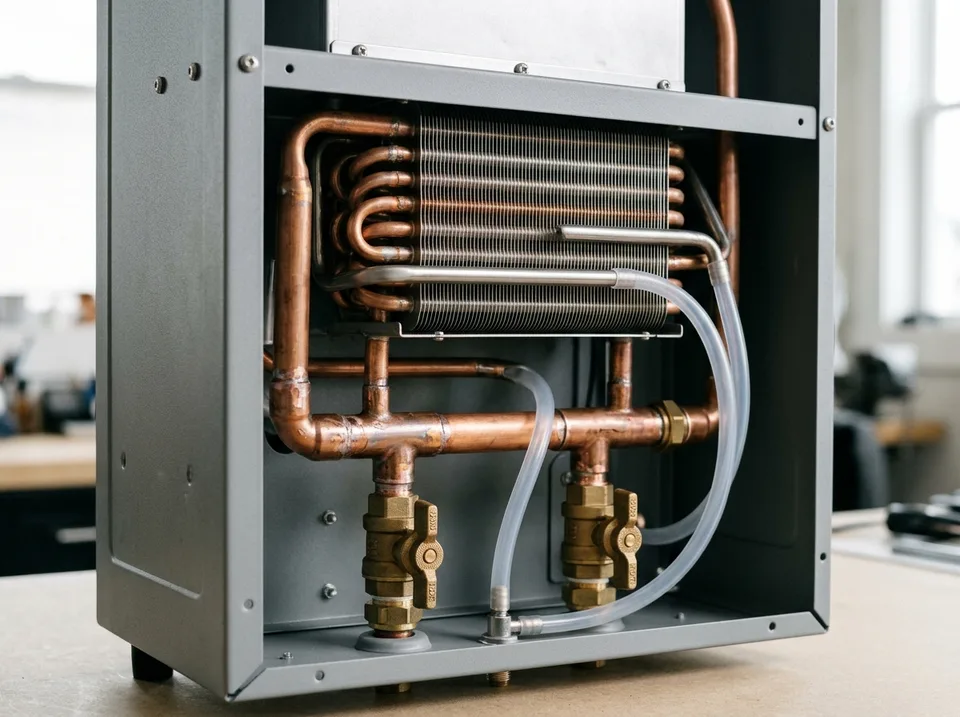
Hidden retrofit cost trigger: swapping a 40,000 BTU/h tank for a 199,000 BTU/h tankless burner exceeds 1/2 in. Sch 40 gas pipe capacity past 10 ft under IFGC Table 402.4(2).
All-electric comparison: at 18.16 cents/kWh, a 3.75 UEF HPWH (706 models) spends ~$163/yr vs. ~$654/yr on a 0.92 UEF resistance tank.
Why Does Tankless Installation Cost More Up Front Than a Storage Tank?
Tank-to-tankless retrofits rarely reuse existing utility connections. Condensing 199,000 BTU/h units require Category IV PVC exhaust venting, a condensate drain with neutralizer, and 3/4 in. or 1 in. Schedule 40 gas piping when existing 1/2 in. iron lines exceed 10 ft.
When Does a Hybrid Heat Pump Tank Beat Gas Tankless on 10-Year Cost?
Where a basement or garage offers at least 450 cu ft of air space and a 240V/30A circuit, hybrid heat pump tanks cost ~4.5–8.5 labor hours to install and may qualify for state DOE HEAR rebates up to $1,750 for households at or below 150% AMI.
How Do Tank, Gas Tankless, and Heat Pump Water Heater Costs Compare?
Every threshold below is sourced from U.S. government datasets, published model code section citations, or OEM service documentation.
| Platform | Equipment Span | Labor Hours | Modeled Labor | Design Life | 2029 Rule Status |
|---|---|---|---|---|---|
| 40–50 Gal Storage Tank | $650–$1,450 | 3.0–5.5 hrs | ~$222 | 8–12 yrs | Elec >35g shifts >=2.30 UEF |
| 199K Gas Condensing Tankless | $1,350–$2,650 | 6.5–12.0 hrs | ~$497 | 15–20 yrs | Clears >=0.91 UEF floor |
| 50–80 Gal Heat Pump (HPWH) | $1,650–$2,950 | 4.5–8.5 hrs | ~$333 | 10–15 yrs | Clears >=2.30–2.50 UEF |
Who Should Not Upgrade to Gas Tankless Purely for Utility Savings?
High-efficiency tankless equipment lowers standby losses, yet upfront gas upsizing and annual descaling erase payback in low-draw or very hard-water homes.
Key Limitations & Exclusions
- Small 1-to-2 person households using under 35 gal/day rarely recover $1,500+ in gas-line and venting retrofit labor.
- Tap water >=7.0 GPG requires annual 45-minute vinegar or citric flushes via service isolation valves.
- Homes without natural gas meters should compare 3.75 UEF HPWHs rather than paying for propane bulk tank installs.
Which Option Fits Your Situation?
What Do Homeowners Ask Most About This Topic?
Direct answers to common technical, regulatory, and sizing questions sourced from primary U.S. government and OEM documentation.
Can I use 30% vinegar to flush my tankless water heater?
Standard OEM descaling manuals from Rinnai and Navien specify circulating 4 gallons of household 5% food-grade white vinegar or an NSF-approved descaling solution for 30 to 45 minutes. Undiluted 30% concentrated acetic acid can swell elastomeric O-rings and etch brass isolation valve components unless specifically diluted first.
How often should a tankless water heater be cleaned?
OEM manufacturers recommend flushing condensing and non-condensing tankless heat exchangers every 12 months when tap water reaches or exceeds 7.0 GPG USGS Hard classification, and every 6 months in Very Hard water above 10.5 GPG, alongside cleaning the cold-water inlet filter mesh screen.
Should you flush a 10 year old water heater?
Exercise caution before aggressively flushing an unmaintained 10-year-old storage tank water heater, because calcified sediment may already be sealing hairline corrosion pinholes along the bottom seam. Decode your serial number age first; storage tanks average 8–12 years, whereas a 10-year-old tankless exchanger with clean brass valves still benefits from annual descaling.
Why are plumbers against tankless water heaters?
Field plumbers flag tank-to-tankless retrofits mainly when homeowners expect a drop-in swap. A 199,000 BTU/h gas tankless unit often exceeds existing 1/2 in. Sch 40 gas capacity beyond 10 ft under IFGC Table 402.4, requires Category IV PVC venting, and needs annual descaling in hard water above 7.0 GPG.
How big of a tankless water heater do I need to replace a 40 gallon water heater?
Size replacement tankless units by peak simultaneous GPM flow and incoming winter groundwater temperature rise rather than gallon count. Two concurrent 2.0 GPM showers plus a kitchen tap demand 5.0–6.0 GPM; at 50 °F incoming water heated to 120 °F, that requires 175,000–199,000 BTU/h gas or 27–36 kW electric.
What size tankless water heater for 3 bedroom 2 bath house?
A 3-bedroom, 2-bath residence running two simultaneous 2.0 GPM showers and a dishwasher typically requires 5.5–7.5 GPM output at a 60–70 °F temperature rise. That matches a 180,000–199,000 BTU/h condensing gas unit (0.91–0.96 UEF) or a 27–36 kW 240V electric model requiring 112–150 amps.
What is the most common problem with tankless water heaters?
Ignition lockouts such as Rinnai 11 and Navien E003 during peak demand are the leading installation fault, commonly caused by undersized 1/2 in. gas piping unable to carry 199 CFH under IFGC Table 402.4. In service, mineral scale buildup above 7.0 GPG hardness and dirty flame sensors rank next.
What's the average lifespan of a water heater?
Standard atmospheric gas and electric resistance storage tanks average 8 to 12 years, depending on tap water hardness and 4-to-6-year sacrificial anode rod replacement. Condensing gas tankless heat exchangers average 15 to 20 years when flushed annually and kept free of calcium scale.
Sources
- OEWS State Employment & Wage Estimates — SOC 47-2152 Plumbers, Pipefitters, and Steamfitters — U.S. Bureau of Labor Statistics, May 2024 OEWS (retrieved 2026-11-23)
- 10 CFR 430.32 — Energy and Water Conservation Standards (Water Heaters & Plumbing Fixtures) — U.S. Department of Energy / eCFR, 2026 eCFR (incl. May 6, 2029 Rule) (retrieved 2026-11-23)
- EIA Electric Power Monthly Table 5.6.A — Average Residential Electricity Price by State — U.S. Energy Information Administration (EIA), August 2026 Monthly Release (retrieved 2026-11-23)
- International Plumbing Code (IPC) & International Fuel Gas Code (IFGC Table 402.4) — International Code Council (ICC), 2021 / 2024 IPC & IFGC (retrieved 2026-11-23)
- DOE Home Energy Rebates Programs (HEAR/HOMES) & OBBBA (P.L. 119-21) Status — U.S. Department of Energy, 2026 Program Guidance (retrieved 2026-11-23)