
Water Heater Anode Rod Types, 3/4 in. NPT Boss & Replacement Guide
Every glass-lined steel storage water heater depends on a 3/4 in. NPT threaded sacrificial anode rod (ASME B1.20.1) to corrode electrochemically instead of the tank wall. Inspect anode rods every 4–6 years: once more than 6 inches of steel core wire shows, replace Magnesium rods (or switch to Aluminum-Zinc to eliminate rotten-egg hydrogen sulfide odor). Every benchmark on this page cites primary U.S. government data, IPC/UPC section standards, or official OEM manuals without sponsored rankings.
- Anode Boss Thread
- 3/4 in. NPT Tapered
- Inspection Interval
- Every 4–6 Years
- Sulfur Odor Fix
- Aluminum-Zinc / Titanium
- Wrench Socket Size
- 1-1/16 in. Hex
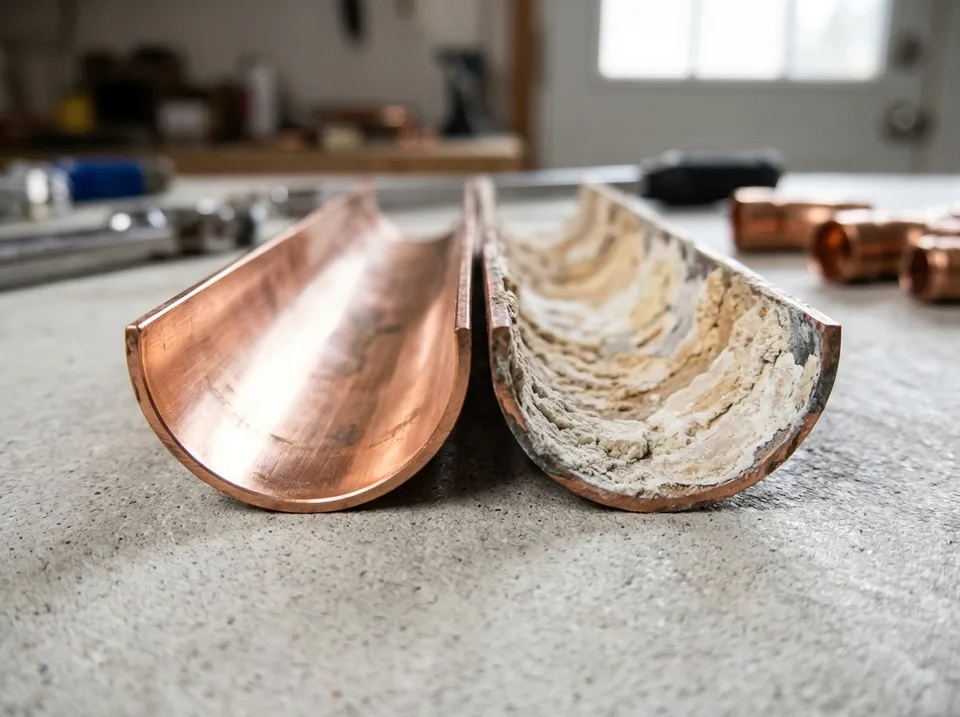
Softened water accelerates anode wear: ion-exchange water softeners increase water conductivity—powered titanium anodes prevent rapid rod depletion and black sediment.
Segmented flexible anodes solve low basement ceilings (<72 in. headroom) where rigid 44-inch straight rods hit floor joists during extraction.
Which Anode Rod Material Matches Your Tap Water Chemistry?
Standard Magnesium rods offer strong corrosion protection in neutral municipal water, Aluminum-Zinc rods halt sulfate-reducing bacteria rotten-egg smells in hot water, and Powered Titanium anodes last indefinitely without adding metal ions.
How Do You Safely Unthread a Seized 1-1/16 in. Hex Anode Rod?
Shut off the cold inlet valve and power/gas first, drain 3–5 gallons to relieve pressure while leaving the tank heavy enough not to spin, and use a 1/2 in. breaker bar or impact wrench with PTFE tape on the 3/4 in. NPT replacement threads.
When Should You Skip Replacing an Anode Rod?
Forcing a rusted anode boss on an already leaking or 12+ year tank risks tearing weakened tank top spuds.
Key Limitations & Exclusions
- If water already weeps from the bottom jacket seam, anode replacement cannot seal cracked steel.
- On 10+ year unmaintained tanks, verify serial age first before spending labor on seized hex heads.
- Do not confuse hot-water hydrogen sulfide odor with natural gas mercaptan leaks around burner doors.
Which Option Fits Your Situation?
What Do Homeowners Ask Most About This Topic?
Direct answers to common technical, regulatory, and sizing questions sourced from primary U.S. government and OEM documentation.
Can I use 30% vinegar to flush my tankless water heater?
Standard OEM descaling manuals from Rinnai and Navien specify circulating 4 gallons of household 5% food-grade white vinegar or an NSF-approved descaling solution for 30 to 45 minutes. Undiluted 30% concentrated acetic acid can swell elastomeric O-rings and etch brass isolation valve components unless specifically diluted first.
How often should a tankless water heater be cleaned?
OEM manufacturers recommend flushing condensing and non-condensing tankless heat exchangers every 12 months when tap water reaches or exceeds 7.0 GPG USGS Hard classification, and every 6 months in Very Hard water above 10.5 GPG, alongside cleaning the cold-water inlet filter mesh screen.
Should you flush a 10 year old water heater?
Exercise caution before aggressively flushing an unmaintained 10-year-old storage tank water heater, because calcified sediment may already be sealing hairline corrosion pinholes along the bottom seam. Decode your serial number age first; storage tanks average 8–12 years, whereas a 10-year-old tankless exchanger with clean brass valves still benefits from annual descaling.
Why are plumbers against tankless water heaters?
Field plumbers flag tank-to-tankless retrofits mainly when homeowners expect a drop-in swap. A 199,000 BTU/h gas tankless unit often exceeds existing 1/2 in. Sch 40 gas capacity beyond 10 ft under IFGC Table 402.4, requires Category IV PVC venting, and needs annual descaling in hard water above 7.0 GPG.
How big of a tankless water heater do I need to replace a 40 gallon water heater?
Size replacement tankless units by peak simultaneous GPM flow and incoming winter groundwater temperature rise rather than gallon count. Two concurrent 2.0 GPM showers plus a kitchen tap demand 5.0–6.0 GPM; at 50 °F incoming water heated to 120 °F, that requires 175,000–199,000 BTU/h gas or 27–36 kW electric.
What size tankless water heater for 3 bedroom 2 bath house?
A 3-bedroom, 2-bath residence running two simultaneous 2.0 GPM showers and a dishwasher typically requires 5.5–7.5 GPM output at a 60–70 °F temperature rise. That matches a 180,000–199,000 BTU/h condensing gas unit (0.91–0.96 UEF) or a 27–36 kW 240V electric model requiring 112–150 amps.
What is the most common problem with tankless water heaters?
Ignition lockouts such as Rinnai 11 and Navien E003 during peak demand are the leading installation fault, commonly caused by undersized 1/2 in. gas piping unable to carry 199 CFH under IFGC Table 402.4. In service, mineral scale buildup above 7.0 GPG hardness and dirty flame sensors rank next.
What's the average lifespan of a water heater?
Standard atmospheric gas and electric resistance storage tanks average 8 to 12 years, depending on tap water hardness and 4-to-6-year sacrificial anode rod replacement. Condensing gas tankless heat exchangers average 15 to 20 years when flushed annually and kept free of calcium scale.
Sources
- A. O. Smith Residential Water Heater Serial Number & Diagnostics Documentation — A. O. Smith Corporation, OEM Technical Bulletins (retrieved 2026-11-23)
- Bradford White ICON System Diagnostic Blink Codes & Date Code Guide — Bradford White Corporation, ICON Gas Control Service Manual (retrieved 2026-11-23)
- ASTM B88 Copper Water Tube & ASME B1.20.1 Pipe Threads — ASTM International & ASME, ASTM B88 / F876 / ASME B1.20.1 (retrieved 2026-11-23)
- National Water Quality Monitoring Council Water Quality Portal (Hardness, Ca, Mg) — USGS & U.S. EPA, WQP Result Service (retrieved 2026-11-23)