
Water Heater Repair vs. Replace: Serial Age, Cost & Safety Rules
Replace rather than repair any storage tank water heater showing rust weeping from the steel jacket seam or sitting past 8–12 years of service life. Use the OEM serial prefix to decode age first: repairable thermopiles, T&P valves, or anode rods make sense under 7 years, whereas 10+ year tanks justify budgeting a $222 BLS baseline labor swap toward May 6, 2029 compliant units.
- Tank Design Life
- 8–12 Years
- Tankless Life
- 15–20 Years
- Standard OEM Warranty
- 6–12 Years
- Swap Labor Baseline
- ~$222 (4 hrs BLS)
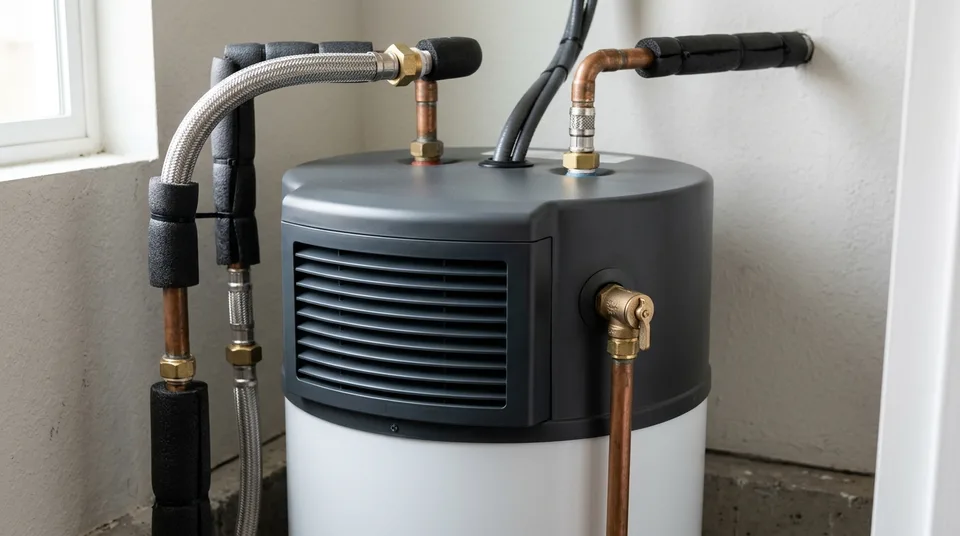
Jacket seam leak = zero repair path: water dripping beneath the outer sheet-metal base indicates a corroded inner glass-lined steel vessel.
Warranty parts check: Rheem, Bradford White, and A. O. Smith gas control valves often carry 6-year factory parts warranties—decode your serial number before paying full retail.
Which Water Heater Failures Are Worth Repairing Under 8 Years Old?
Thermopile pilot sensors (Bradford White 6 flashes), heating elements, thermostats, expansion tanks, and T&P relief valves are external serviceable parts. On units under 7–8 years old with a dry outer base, replacing these components restores safe operation quickly.
When Does Repairing an Aging Tank Waste Money?
Once a storage tank crosses 9–12 years—especially in >=7.0 GPG hard water—aggressive sediment flushing can dislodge scale sealing hairline corrosion spots, and paying $400+ for an out-of-warranty gas control valve leaves the aging tank shell vulnerable.
When Should You Never Attempt DIY Water Heater Repair?
Gas valve replacements, sealed-chamber burner diagnostics, and 240V breaker faults carry explosion, carbon monoxide, and shock hazards.
Key Limitations & Exclusions
- Evacuate and call 911 immediately if you smell mercaptan gas near the burner or basement floor.
- Never cap a dripping T&P relief pipe (rated 150 psi / 210 °F); inspect expansion tank pressure instead.
- Verify active CPSC recalls on your model before investing in parts.
Which Option Fits Your Situation?
What Do Homeowners Ask Most About This Topic?
Direct answers to common technical, regulatory, and sizing questions sourced from primary U.S. government and OEM documentation.
Can I use 30% vinegar to flush my tankless water heater?
Standard OEM descaling manuals from Rinnai and Navien specify circulating 4 gallons of household 5% food-grade white vinegar or an NSF-approved descaling solution for 30 to 45 minutes. Undiluted 30% concentrated acetic acid can swell elastomeric O-rings and etch brass isolation valve components unless specifically diluted first.
How often should a tankless water heater be cleaned?
OEM manufacturers recommend flushing condensing and non-condensing tankless heat exchangers every 12 months when tap water reaches or exceeds 7.0 GPG USGS Hard classification, and every 6 months in Very Hard water above 10.5 GPG, alongside cleaning the cold-water inlet filter mesh screen.
Should you flush a 10 year old water heater?
Exercise caution before aggressively flushing an unmaintained 10-year-old storage tank water heater, because calcified sediment may already be sealing hairline corrosion pinholes along the bottom seam. Decode your serial number age first; storage tanks average 8–12 years, whereas a 10-year-old tankless exchanger with clean brass valves still benefits from annual descaling.
Why are plumbers against tankless water heaters?
Field plumbers flag tank-to-tankless retrofits mainly when homeowners expect a drop-in swap. A 199,000 BTU/h gas tankless unit often exceeds existing 1/2 in. Sch 40 gas capacity beyond 10 ft under IFGC Table 402.4, requires Category IV PVC venting, and needs annual descaling in hard water above 7.0 GPG.
How big of a tankless water heater do I need to replace a 40 gallon water heater?
Size replacement tankless units by peak simultaneous GPM flow and incoming winter groundwater temperature rise rather than gallon count. Two concurrent 2.0 GPM showers plus a kitchen tap demand 5.0–6.0 GPM; at 50 °F incoming water heated to 120 °F, that requires 175,000–199,000 BTU/h gas or 27–36 kW electric.
What size tankless water heater for 3 bedroom 2 bath house?
A 3-bedroom, 2-bath residence running two simultaneous 2.0 GPM showers and a dishwasher typically requires 5.5–7.5 GPM output at a 60–70 °F temperature rise. That matches a 180,000–199,000 BTU/h condensing gas unit (0.91–0.96 UEF) or a 27–36 kW 240V electric model requiring 112–150 amps.
What is the most common problem with tankless water heaters?
Ignition lockouts such as Rinnai 11 and Navien E003 during peak demand are the leading installation fault, commonly caused by undersized 1/2 in. gas piping unable to carry 199 CFH under IFGC Table 402.4. In service, mineral scale buildup above 7.0 GPG hardness and dirty flame sensors rank next.
What's the average lifespan of a water heater?
Standard atmospheric gas and electric resistance storage tanks average 8 to 12 years, depending on tap water hardness and 4-to-6-year sacrificial anode rod replacement. Condensing gas tankless heat exchangers average 15 to 20 years when flushed annually and kept free of calcium scale.
Sources
- A. O. Smith Residential Water Heater Serial Number & Diagnostics Documentation — A. O. Smith Corporation, OEM Technical Bulletins (retrieved 2026-11-23)
- Rheem & Ruud Water Heater Status Code & Warranty Date Code Reference — Rheem Manufacturing Company, OEM Service & Diagnostic Sheets (retrieved 2026-11-23)
- Bradford White ICON System Diagnostic Blink Codes & Date Code Guide — Bradford White Corporation, ICON Gas Control Service Manual (retrieved 2026-11-23)
- CPSC SaferProducts.gov Product Recalls REST API — U.S. Consumer Product Safety Commission, 2026 Live Recalls Feed (retrieved 2026-11-23)
- OEWS State Employment & Wage Estimates — SOC 47-2152 Plumbers, Pipefitters, and Steamfitters — U.S. Bureau of Labor Statistics, May 2024 OEWS (retrieved 2026-11-23)
- 10 CFR 430.32 — Energy and Water Conservation Standards (Water Heaters & Plumbing Fixtures) — U.S. Department of Energy / eCFR, 2026 eCFR (incl. May 6, 2029 Rule) (retrieved 2026-11-23)