
Rinnai REHP80C Water Heater Specifications (4 UEF)
In the 706-unit Hybrid/Electric Heat Pump class, Rinnai REHP80C (Electric) achieves a certified 4.0 UEF rating across its 75-gallon nominal tank, 91 gal First Hour Rating (rank #106 of 706, PD 3531244) and verifies as Pass: +1.50 / +60.0% for 2029 DOE floors. Rated annual electricity draw of 1,225 kWh/yr equates to roughly $222/yr ($2,225 over 10 years) at 18.16 cents/kWh. Closest certified alternative is Midea CAN3-RSJ-15/300RDVN3-L4 (4.0 UEF).
- Uniform Energy Factor
- 4.0 UEF
- Cohort UEF Rank
- #106 of 706 (top 19.8%)
- First Hour Rating
- 91 gal
- Storage Volume
- 75 gal
- Fuel / Type
- Electric / Hybrid/Electric Heat Pump
- DOE 2029 Rule Status
- Pass: +1.50 / +60.0%
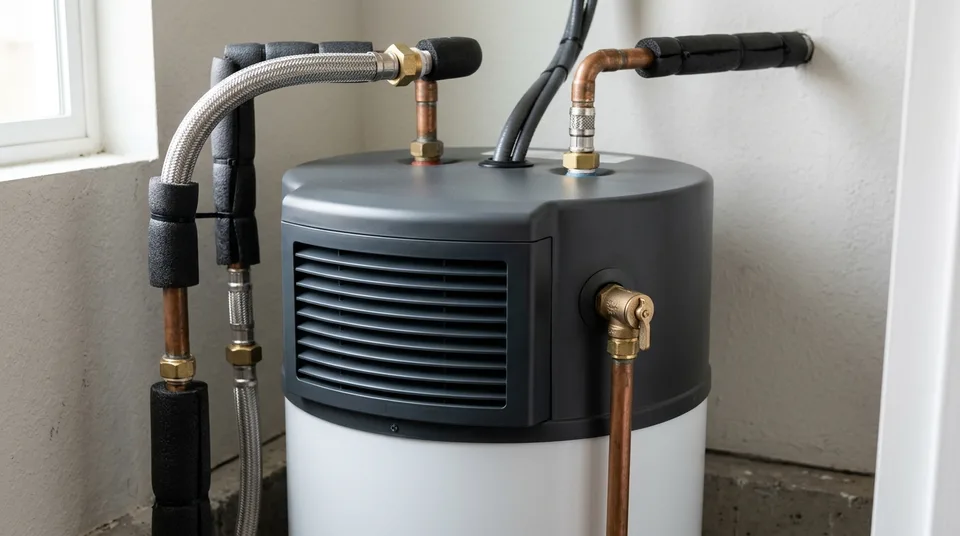
Rinnai REHP80C records 4.0 UEF efficiency, putting it #106 of 706 among 706 Hybrid/Electric Heat Pump peers.
10 CFR 430.32(d)(2) compliance: Rinnai REHP80C exceeds 10 CFR 430.32(d)(2) Electric >55 to <=120 gal (2.50 UEF) by +1.50 UEF (+60.0%). At EIA August 2026 national rates (18.16 cents/kWh), 1,225 kWh/yr for Rinnai REHP80C runs ~$222/yr vs. ~$967/yr for a 0.92 UEF electric tank. Acoustic output is 49 dBA (quieter than 12.8% of Hybrid/Electric Heat Pump models).
State electric sensitivity for Rinnai REHP80C: 10-year operating spend spans $1,792 in Washington (Lowest Hydro Tier) (14.63 cents/kWh) to $5,780 in Hawaii (Highest EIA State) (47.18 cents/kWh).
Competing options beside Rinnai REHP80C (4.0 UEF) are Midea CAN3-RSJ-15/300RDVN3-L4 (4.0 UEF, at parity) and Bradford White RE2HP80**-1NCTT (4.0 UEF, at parity).
How Complete Are the Certified Metrics for Rinnai REHP80C?
Standing at #106 of 706 (top 19.8%) among 706 certified Hybrid/Electric Heat Pump heaters, Rinnai REHP80C brings measurable deltas in recovery, footprint, and energy efficiency.
| Specification Attribute | Certified Value | Cohort Benchmark / Delta | Provenance |
|---|---|---|---|
| Manufacturer / Brand | Rinnai | 25 certified listings | ENERGY STAR PD 3531244 |
| Model Number | REHP80C | Draw pattern: High-Usage | REHP80C |
| Uniform Energy Factor (UEF) | 4.0 | +0.30 UEF vs. 3.70 UEF median | 10 CFR 430 Test Method |
| First Hour Rating (FHR) | 91 gal | +19 gal vs. 72 gal median | 10 CFR 430 Recovery Test |
| Rated Annual Electricity Use | 1,225 kWh/yr | +153 kWh/yr vs. 1,072 kWh/yr median | Est. $222/yr @ $0.1816/kWh (EIA US Avg) |
| Thermal Recovery Efficiency | 454% | +25.0 pts vs. 429.0% median | ENERGY STAR Dataset |
| Physical Envelope (H x Dia) | 74.2" H x 25.7" D | Needs >72 in. overhead clearance; clears 28 in. utility doorway (25.7" D) | Doorway & ceiling check |
| Electrical Circuit Requirements | 240 V / 24 A max | Requires 240V dedicated branch circuit; check panel capacity | NEC / Branch circuit check |
| Heat Pump Refrigerant & GWP | R-134a (GWP:1430) | Check regional AIM Act phase-down transition | EPA AIM Act Compliance |
| Sound Pressure Level | 49 dBA | quieter than 12.8% of Hybrid/Electric Heat Pump models · At 49 dBA median | Indoor placement check |
| Certification Date | 2026-03-24 | Certified 2026-03-24 | Markets: United States, Canada |
What Is the Projected Utility Bill for REHP80C by State?
At 1,225 kWh/yr, Rinnai REHP80C averages about $222/yr across US households—see 10-year payback spreads versus 0.92 UEF resistance tanks.
| Jurisdiction (EIA Aug 2026) | Residential Rate | Annual Cost | 10-Yr Operating Spend | 10-Yr Savings vs. 0.92 UEF |
|---|---|---|---|---|
| United States Average | 18.16 ¢/kWh ($0.1816) | $222/yr | $2,225 | $7,447 |
| Hawaii (Highest EIA State) | 47.18 ¢/kWh ($0.4718) | $578/yr | $5,780 | $19,349 |
| California | 29.75 ¢/kWh ($0.2975) | $364/yr | $3,644 | $12,200 |
| Texas | 15.91 ¢/kWh ($0.1591) | $195/yr | $1,949 | $6,525 |
| Washington (Lowest Hydro Tier) | 14.63 ¢/kWh ($0.1463) | $179/yr | $1,792 | $6,000 |
Are Rinnai Models Affected by Current CPSC Notices?
Zero brand-level CPSC hazard notices matched Rinnai in our 2026-11-23 feed; decode your water heater's serial number below to confirm warranty status. See Serial Number Lookup.
Which 5 Models Offer Similar Output to REHP80C?
Ordered by minimal capacity and UEF spread relative to Rinnai REHP80C, these five certified peers give direct replacement benchmarks.
| Brand & Model | Type | Vol | FHR | UEF (Δ) | kWh/yr |
|---|---|---|---|---|---|
| Midea CAN3-RSJ-15/300RDVN3-L4 | Hybrid/Electric Heat Pump | 75 gal | 91 gal | 4.0 (at parity) | 1,230 |
| Bradford White RE2HP80**-1NCTT | Hybrid/Electric Heat Pump | 75 gal | 88 gal | 4.0 (at parity) | 1,240 |
| JETGLAS RE2HP80*-1NCTT | Hybrid/Electric Heat Pump | 75 gal | 88 gal | 4.0 (at parity) | 1,240 |
| 1HVAC ACIQ-80G-HP-WH | Hybrid/Electric Heat Pump | 74 gal | 91 gal | 4.0 (at parity) | 1,240 |
| Midea MAHW-80VN3B | Hybrid/Electric Heat Pump | 75 gal | 91 gal | 4.0 (at parity) | 1,230 |
When Should Homeowners Skip Rinnai REHP80C (Hybrid/Electric Heat Pump)?
Check Rinnai REHP80C's mechanical constraints—including utility space, Electric capacity, and Pass: +1.50 / +60.0% status—against typical residential installations.
Key Limitations & Exclusions
- Rinnai REHP80C needs >=450 cu ft room air volume or ducting so compressor cooling does not stall recovery.
- Compressor runs near 49 dBA; avoid mounting Rinnai REHP80C directly beside quiet bedrooms.
- Requires condensate drain routing and 240V electrical capacity; verify state DOE HEAR status.
Which Option Fits Your Situation?
Practical Specs & Code Questions for Rinnai REHP80C
Direct answers to common technical, regulatory, and sizing questions sourced from primary U.S. government and OEM documentation.
Will Rinnai REHP80C stay compliant after the May 6, 2029 DOE standard takes effect?
Tested at 4.0 UEF, Rinnai REHP80C shows Pass: +1.50 / +60.0% relative to May 6, 2029 federal DOE limits while placing #106 of 706 (top 19.8%) among 706 Hybrid/Electric Heat Pump peers like Midea CAN3-RSJ-15/300RDVN3-L4.
Will Rinnai REHP80C fit through a standard utility door and 72-inch basement ceiling?
Measuring 74.2 in. tall by 25.7 in. diameter, Rinnai REHP80C notes: needs >72 in. overhead clearance; clears 28 in. utility doorway (25.7" d). Reserve space above the jacket for T&P piping and anode removal.
Do existing utility hookups support Rinnai REHP80C during replacement?
Electrical specs for Rinnai REHP80C call for 240V at 24A max (Requires 240V dedicated branch circuit; check panel capacity). Have a licensed electrician inspect panel load and wire gauge.
What is the estimated 10-year operating spend for Rinnai REHP80C?
At 18.16 cents/kWh national residential pricing, Rinnai REHP80C's 1,225 kWh/yr draw equals roughly $222 annually or $2,220 across a 10-year horizon (ranging from $179/yr in Washington hydro tiers up to $578/yr in Hawaii).
When is Rinnai REHP80C a poor fit for a residential replacement?
Avoid placing Rinnai REHP80C directly next to bedrooms or inside tight <300 cu ft closets without ducting, due to 49 dBA sound and cool exhaust airflow.
What First Hour Rating or flow capacity does Rinnai REHP80C deliver?
With 91 gal FHR (+19 gal vs. 72 gal median), Rinnai REHP80C fits larger 3–5 person homes cleanly.
How do you verify manufacturing age and recall status on Rinnai REHP80C?
Our 2026-11-23 CPSC SaferProducts feed lists zero recalls for Rinnai; verify exact manufacturing week for Rinnai REHP80C using the Serial Number Lookup tool.
Does Rinnai REHP80C qualify for DOE HEAR incentives after 25C expired?
After 25C sunset on Dec 31, 2025 under OBBBA, check state DOE HEAR (up to $1,750 income-qualified) and utility rebates for Rinnai REHP80C. Closest peer in Hybrid/Electric Heat Pump is Midea CAN3-RSJ-15/300RDVN3-L4 (4.0 UEF).
Sources
- ENERGY STAR Certified Water Heaters Dataset (Socrata pbpq-swnu) — U.S. EPA & DOE ENERGY STAR, 2026 Live Certified Registry (retrieved 2026-11-23)
- 10 CFR 430.32 — Energy and Water Conservation Standards (Water Heaters & Plumbing Fixtures) — U.S. Department of Energy / eCFR, 2026 eCFR (incl. May 6, 2029 Rule) (retrieved 2026-11-23)
- CPSC SaferProducts.gov Product Recalls REST API — U.S. Consumer Product Safety Commission, 2026 Live Recalls Feed (retrieved 2026-11-23)
- EIA Electric Power Monthly Table 5.6.A — Average Residential Electricity Price by State — U.S. Energy Information Administration (EIA), August 2026 Monthly Release (retrieved 2026-11-23)