
Rinnai REHP50CW Water Heater Specifications (3.75 UEF)
In the 706-unit Hybrid/Electric Heat Pump class, Rinnai REHP50CW (Electric) achieves a certified 3.75 UEF rating across its 46-gallon nominal tank, 71 gal First Hour Rating (rank #297 of 706, PD 4654894) and verifies as Pass: +1.45 / +63.0% for 2029 DOE floors. Rated annual electricity draw of 861 kWh/yr equates to roughly $156/yr ($1,564 over 10 years) at 18.16 cents/kWh. Closest certified alternative is Midea CAN3-RSJ-15/190RDVN3-L4 (3.75 UEF).
- Uniform Energy Factor
- 3.75 UEF
- Cohort UEF Rank
- #297 of 706
- First Hour Rating
- 71 gal
- Storage Volume
- 46 gal
- Fuel / Type
- Electric / Hybrid/Electric Heat Pump
- DOE 2029 Rule Status
- Pass: +1.45 / +63.0%
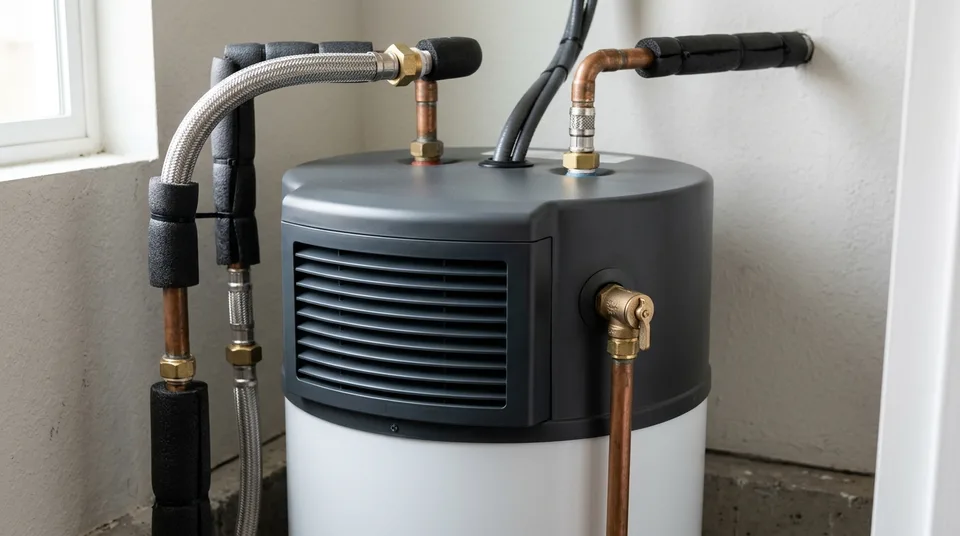
Rinnai REHP50CW records 3.75 UEF efficiency, putting it #297 of 706 among 706 Hybrid/Electric Heat Pump peers.
10 CFR 430.32(d)(2) compliance: Rinnai REHP50CW exceeds 10 CFR 430.32(d)(2) Electric >35 to <=55 gal (2.30 UEF) by +1.45 UEF (+63.0%). At EIA August 2026 national rates (18.16 cents/kWh), 861 kWh/yr for Rinnai REHP50CW runs ~$156/yr vs. ~$637/yr for a 0.92 UEF electric tank. Acoustic output is 49 dBA (quieter than 12.8% of Hybrid/Electric Heat Pump models).
State electric sensitivity for Rinnai REHP50CW: 10-year operating spend spans $1,260 in Washington (Lowest Hydro Tier) (14.63 cents/kWh) to $4,062 in Hawaii (Highest EIA State) (47.18 cents/kWh).
Competing options beside Rinnai REHP50CW (3.75 UEF) are Midea CAN3-RSJ-15/190RDVN3-L4 (3.75 UEF, at parity) and A. O. Smith HPS10-50H45DV 2** (3.8 UEF, delta +0.05).
How Do Rinnai REHP50CW Specs Compare to Hybrid/Electric Heat Pump Medians?
Rinnai REHP50CW places #297 of 706 across 706 certified Hybrid/Electric Heat Pump configurations, with physical dimensions, draw profile, and thermal metrics benchmarked below.
| Specification Attribute | Certified Value | Cohort Benchmark / Delta | Provenance |
|---|---|---|---|
| Manufacturer / Brand | Rinnai | 25 certified listings | ENERGY STAR PD 4654894 |
| Model Number | REHP50CW | Draw pattern: Medium-Usage | REHP50CW |
| Uniform Energy Factor (UEF) | 3.75 | +0.05 UEF vs. 3.70 UEF median | 10 CFR 430 Test Method |
| First Hour Rating (FHR) | 71 gal | -1 gal vs. 72 gal median | 10 CFR 430 Recovery Test |
| Rated Annual Electricity Use | 861 kWh/yr | -211 kWh/yr vs. 1,072 kWh/yr median | Est. $156/yr @ $0.1816/kWh (EIA US Avg) |
| Thermal Recovery Efficiency | 420% | -9.0 pts vs. 429.0% median | ENERGY STAR Dataset |
| Physical Envelope (H x Dia) | 46.6" H x 18.3" D | Fits standard 72 in. basement/garage clearance; clears 28 in. utility doorway (18.3" D) | Doorway & ceiling check |
| Electrical Circuit Requirements | 240 V / 24 A max | Requires 240V dedicated branch circuit; check panel capacity | NEC / Branch circuit check |
| Heat Pump Refrigerant & GWP | R-134a (GWP:1430) | Check regional AIM Act phase-down transition | EPA AIM Act Compliance |
| Sound Pressure Level | 49 dBA | quieter than 12.8% of Hybrid/Electric Heat Pump models · At 49 dBA median | Indoor placement check |
| Certification Date | 2026-07-23 | Certified 2026-07-23 | Markets: United States, Canada |
What Does REHP50CW Cost to Operate Across State Electricity Rates?
At 861 kWh/yr, Rinnai REHP50CW runs roughly $156/yr on the EIA national average tier under August 2026 Table 5.6.A rates.
| Jurisdiction (EIA Aug 2026) | Residential Rate | Annual Cost | 10-Yr Operating Spend | 10-Yr Savings vs. 0.92 UEF |
|---|---|---|---|---|
| United States Average | 18.16 ¢/kWh ($0.1816) | $156/yr | $1,564 | $4,811 |
| Hawaii (Highest EIA State) | 47.18 ¢/kWh ($0.4718) | $406/yr | $4,062 | $12,498 |
| California | 29.75 ¢/kWh ($0.2975) | $256/yr | $2,561 | $7,881 |
| Texas | 15.91 ¢/kWh ($0.1591) | $137/yr | $1,370 | $4,215 |
| Washington (Lowest Hydro Tier) | 14.63 ¢/kWh ($0.1463) | $126/yr | $1,260 | $3,875 |
Are There Active CPSC Safety Recalls for Rinnai Water Heaters?
Zero active CPSC recalls matched Rinnai in our 2026-11-23 SaferProducts sweep; verify your individual tank date code via our lookup tool. See Serial Number Lookup.
Which Certified Water Heaters Match REHP50CW Most Closely?
These 5 competing Hybrid/Electric Heat Pump units sit nearest to Rinnai REHP50CW by storage capacity and 3.75 UEF rating.
| Brand & Model | Type | Vol | FHR | UEF (Δ) | kWh/yr |
|---|---|---|---|---|---|
| Midea CAN3-RSJ-15/190RDVN3-L4 | Hybrid/Electric Heat Pump | 46 gal | 71 gal | 3.75 (at parity) | 861 |
| A. O. Smith HPS10-50H45DV 2** | Hybrid/Electric Heat Pump | 46 gal | 65 gal | 3.8 (+0.05) | 831 |
| American HPS10250H045DV 2** | Hybrid/Electric Heat Pump | 46 gal | 65 gal | 3.8 (+0.05) | 831 |
| Lochinvar HPSA050KD 2** | Hybrid/Electric Heat Pump | 46 gal | 65 gal | 3.8 (+0.05) | 831 |
| Midea MAHW-50VN3B | Hybrid/Electric Heat Pump | 46 gal | 71 gal | 3.75 (at parity) | 861 |
Who Is Rinnai REHP50CW Best For — and When Should You Pick Midea CAN3-RSJ-15/190RDVN3-L4?
Evaluate whether Rinnai REHP50CW's Hybrid/Electric Heat Pump architecture matches your existing mechanical room and local utility tariffs before purchasing.
Key Limitations & Exclusions
- Rinnai REHP50CW needs >=450 cu ft room air volume or ducting so compressor cooling does not stall recovery.
- Compressor runs near 49 dBA; avoid mounting Rinnai REHP50CW directly beside quiet bedrooms.
- Requires condensate drain routing and 240V electrical capacity; verify state DOE HEAR status.
Which Option Fits Your Situation?
What Are the Key Questions About Rinnai REHP50CW?
Direct answers to common technical, regulatory, and sizing questions sourced from primary U.S. government and OEM documentation.
How does Rinnai REHP50CW (3.75 UEF) compare to 2029 federal DOE floors?
Evaluated against May 6, 2029 10 CFR 430.32 thresholds, Rinnai REHP50CW records 3.75 UEF (Pass: +1.45 / +63.0%), placing #297 of 706 out of 706 certified Hybrid/Electric Heat Pump configurations.
Does Rinnai REHP50CW fit inside a tight hallway closet or low-headroom utility room?
Rinnai REHP50CW requires room for its 46.6 in. vertical shell and 18.3 in. diameter (fits standard 72 in. basement/garage clearance; clears 28 in. utility doorway (18.3" d)), plus service access for annual sediment draining.
What power supply or fuel line specs govern Rinnai REHP50CW?
For Rinnai REHP50CW, plan a 240V circuit at 24A max (Requires 240V dedicated branch circuit; check panel capacity) and keep a dedicated shutoff disconnect within sight of the unit.
What annual utility bill should homeowners budget for Rinnai REHP50CW?
Using 861 kWh/yr, Rinnai REHP50CW generates an estimated $156/yr electric bill at 18.16 cents/kWh (ranging from $126/yr in Washington hydro tiers up to $406/yr in Hawaii)—use the custom rate slider above for your utility tariff.
What are the main drawbacks of Rinnai REHP50CW (3.75 UEF)?
Rinnai REHP50CW requires >=450 cu ft air space, 240V electrical supply, and drain access; tight interior alcoves favor ducted adapters or Midea CAN3-RSJ-15/190RDVN3-L4.
What hot-water delivery rating governs Rinnai REHP50CW?
Rated for 71 gal FHR (-1 gal vs. 72 gal median), Rinnai REHP50CW prevents mid-morning cold drops when matched to 55–70+ gal multi-bath household loads.
Where do homeowners screen Rinnai REHP50CW for recalls and tank age?
Verified clean against 2026-11-23 CPSC recall feeds for Rinnai; use our browser-only serial decoder to inspect Rinnai REHP50CW's age and warranty window.
What alternative models sit closest to Rinnai REHP50CW in the Hybrid/Electric Heat Pump class?
Closest peer in Hybrid/Electric Heat Pump is Midea CAN3-RSJ-15/190RDVN3-L4 (3.75 UEF). For 2026 incentives, look to state DOE HEAR grants ($1,750 max on qualifying HPWHs) and local municipal utility credits.
Sources
- ENERGY STAR Certified Water Heaters Dataset (Socrata pbpq-swnu) — U.S. EPA & DOE ENERGY STAR, 2026 Live Certified Registry (retrieved 2026-11-23)
- 10 CFR 430.32 — Energy and Water Conservation Standards (Water Heaters & Plumbing Fixtures) — U.S. Department of Energy / eCFR, 2026 eCFR (incl. May 6, 2029 Rule) (retrieved 2026-11-23)
- CPSC SaferProducts.gov Product Recalls REST API — U.S. Consumer Product Safety Commission, 2026 Live Recalls Feed (retrieved 2026-11-23)
- EIA Electric Power Monthly Table 5.6.A — Average Residential Electricity Price by State — U.S. Energy Information Administration (EIA), August 2026 Monthly Release (retrieved 2026-11-23)